
Workplace wellness is shrinking. And that's good news
How to position yourself for the new corporate budget

Hola amigos,
I have exciting opportunities today. By the end of this brief, you will understand exactly
what corporate companies will actually pay for and how executive buyers think internally.
how to position your work to be taken seriously by translating your skills into indispensable business language.
you will gain the strategic edge to build a sustainable, predictable business.
If you're busy, save this email and read it later with coffee.
The wellness economy has reached $6.8 trillion
But if you look closely at the data, a silent correction is happening. While almost every wellness sector is surging, traditional workplace wellness was the only sector to shrink recently, contracting by 1.5% globally.
Yet, the mental wellness market is exploding, growing at 12.4% annually to become a $125 billion market in the US alone.
Even more revealing: Wellness Real Estate, the proactive design of healthy built environments, is the fastest-growing market on earth, skyrocketing at 19.5% annually.
Why is traditional corporate wellness dying while mental wellness and physical infrastructure skyrocket?
Because executive buyers are waking up to a massive data gap. They are realizing that traditional “programmatic” wellness: lunchtime yoga, meditation apps, and step challenges, cannot fix structural, environmental sickness.
The eye opener
If you are pitching a standalone mindfulness class to an HR director, you are selling a micro-level consumer benefit. But that buyer is staring down terrifying macro-level workforce risks.
Look at the data they are dealing with:
The Structural Stress Crisis: A 2024 study on white-collar workers found that high job strain combined with low reward increases the risk of developing irregular heart rhythms (AFib) by a staggering 97%. High job strain alone increases the risk by 83%.
The Overwork Penalty: Working 55 hours a week increases the risk of cardiovascular events by 40%, and every additional hour worked weekly increases the risk of cardiovascular disease by 1%.
The Global Mental Bleed: 7 in 10 people globally report they are struggling mentally, with major depressive and anxiety disorders surging by over 25%.
The Financial Ticking Clock: 75% of all healthcare costs are spent on preventable causes, and the global economic cost of these preventable chronic diseases is estimated to reach $47 trillion by 2030.
The Wellness Intervention Scale
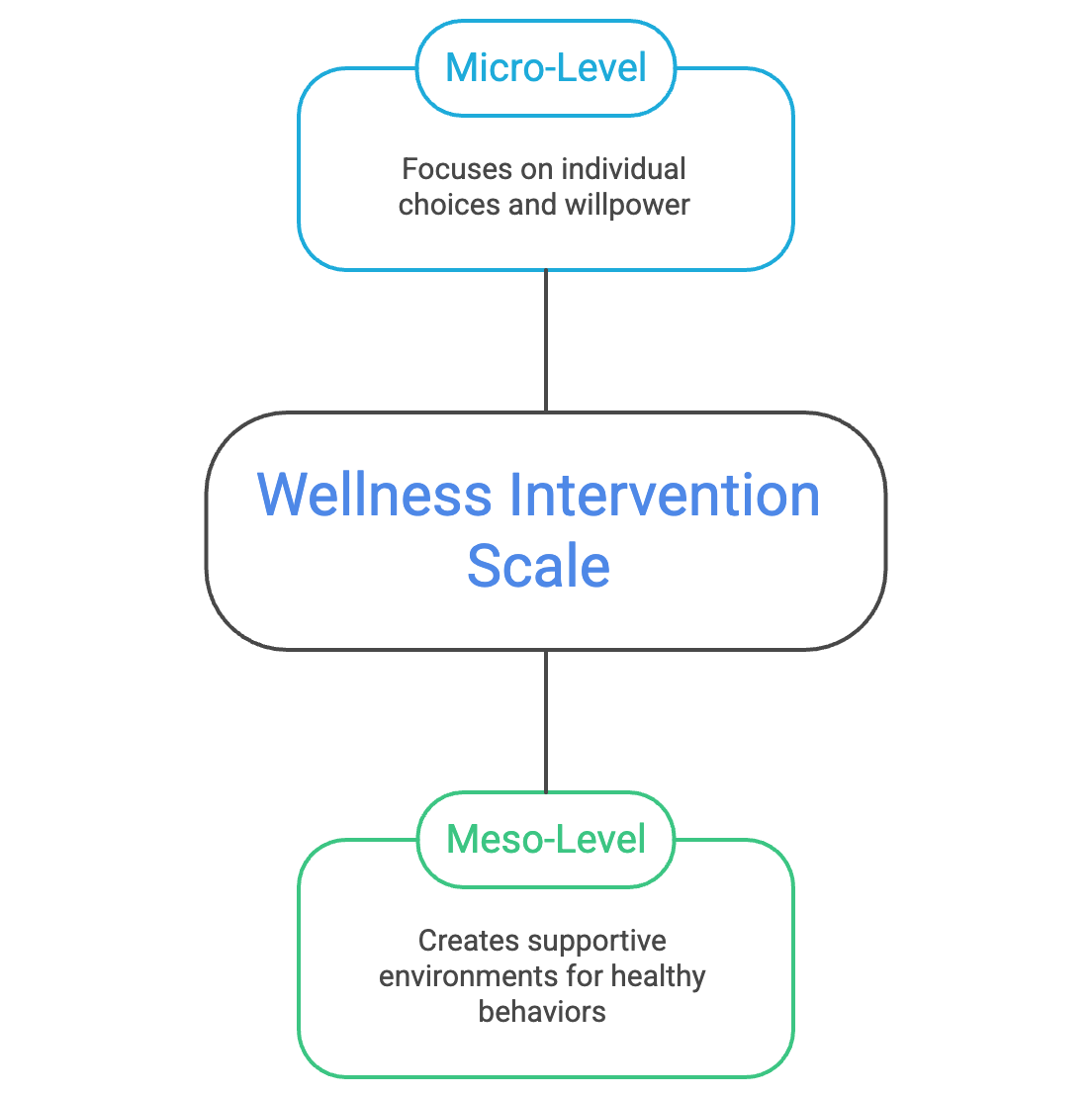
Public policy and architectural experts divide wellness interventions into distinct levels. Understanding this scale is the secret to getting corporate buyers to take you seriously.
The Micro-Level (The Dying Model): This involves encouraging individuals to proactively make healthy choices. It is the meditation app. It is the breathing workshop. It relies on a burnt-out employee finding the time and willpower to fix themselves. This is where 95% of wellness professionals operate, and it is exactly why their proposals are currently being ignored.
The Meso-Level (The Growth Model): This involves creating living and working environments that systematically support and encourage healthy behaviours. It does not ask the employee to change; it changes the ecosystem around them.
The shrinking 1.5% data point represents the death of the micro-level perk. Conversely, the exploding 19.5% growth in wellness real estate and built environments represents the rise of the meso-level infrastructure.
Buyers are moving their budgets away from individual programmes and pouring them into environmental redesigns, cognitive risk protocols, and structural shifts that dictate healthier human behaviour by default.
What this means for your business
What looks like the issue: Employees aren’t engaging with the corporate wellness program.
What buyers actually care about: The structural environment of the job is driving measurable cognitive and physical damage, and no amount of Friday meditation will fix it.
When you pitch “stress relief,” the buyer’s internal logic says, "Our environment is causing a 97% spike in cardiovascular risk, and you want us to buy
them a breathing class?”
It feels like a sticking plaster on a severed artery, doesn’t ’it?
You are asking companies to subsidize individual relaxation when they desperately need to fund environmental redesign.
Below, for my private subscribers paying less than 1 AED a day, I will break down:
how to translate your expertise into the language buyers approve
how to estructure your offer from a “perk” to “infrastructure”
how executive buyers think internally.
how to position your work to be taken seriously
how to translare your skills into business language.
These insights could help you shape a stronger consulting offer, open the door to a new role, or help you spot the kind of project worth saying yes to.
Join me.
How to turn your wellness service into a corporate system
We have established that you must stop pitching consumer perks and start pitching structural risk mitigation. If job strain is causing a 97% increase in severe health risks, your role is to provide the antidote to a toxic structural environment.
Understanding this shift is only the first step. To actually win these contracts, you must change how you package, price, and hand over your proposal so that an executive buyer can effortlessly defend it to their Chief Financial Officer.
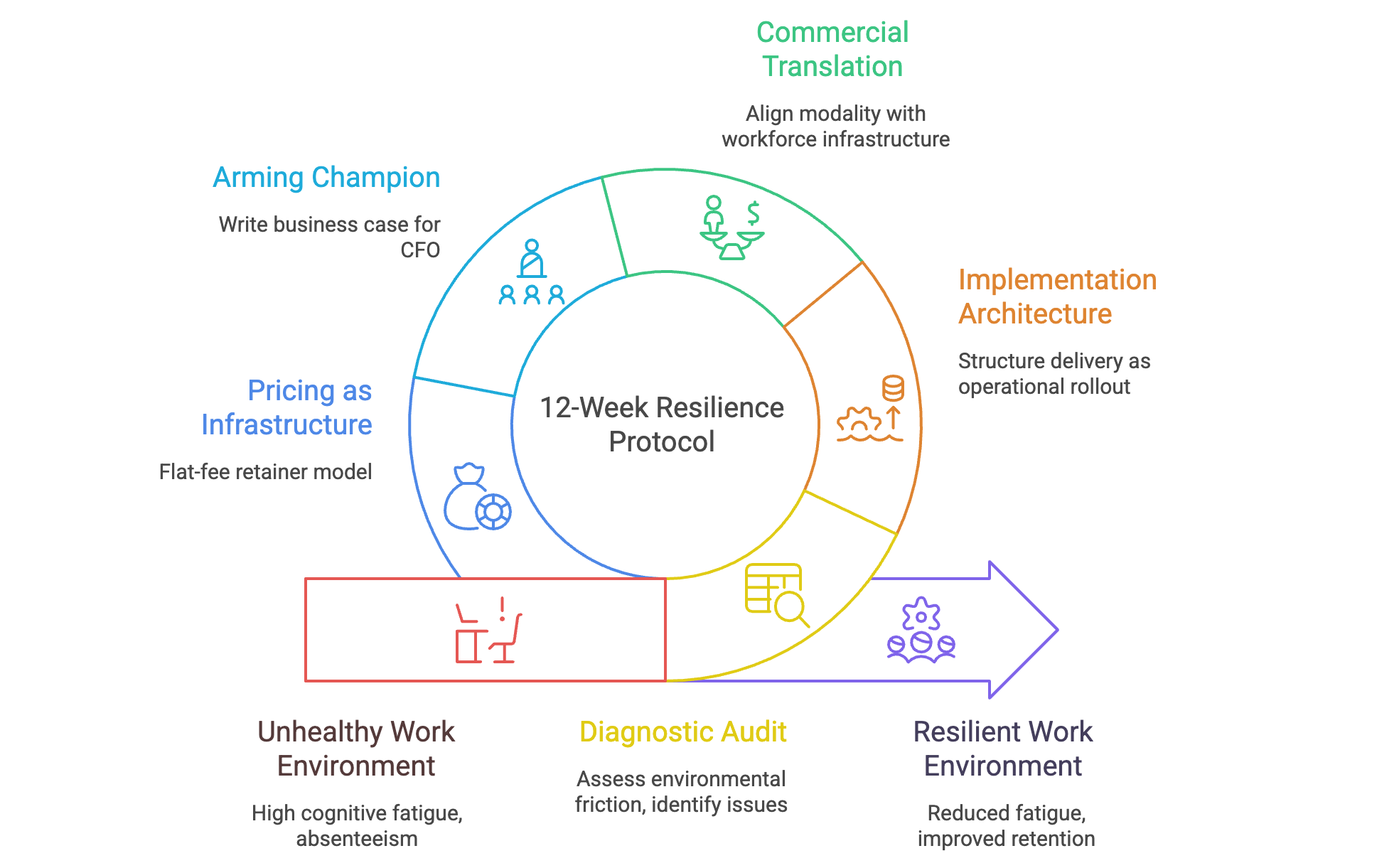
Here is the exact operational blueprint to turn your wellness expertise into corporate infrastructure.
Phase 1: The Diagnostic Audit (What to actually ask)
Never prescribe a solution before conducting an audit. If you sell a workshop before understanding the structural friction of the company, you are a gig worker. If you assess the environment first, you are a consultant.
Before you pitch your service, propose a Cognitive Load Audit. You need to discover why the environment is harming the people. Interview department heads and ask these three specific questions:
The Digital Tethering Metric: “What is the cultural expectation for email and message response times after 7:00 PM and on weekends?” (If the culture demands constant availability, any stress management class you teach will be immediately neutralized by their inbox.)
The Meeting Density Metric: “What percentage of your mid-level managers’ week is spent in back-to-back internal video calls?” (If they have zero recovery windows, you cannot ask them to add an hour-long wellness class to their calendar. You must integrate micro-protocols into their existing schedule.)
The Churn Metric: “Which specific department is experiencing the highest rate of absenteeism or talent turnover this quarter?” (Do not try to repair the whole company at once. Target the bleeding artery. This gives your proposal a measurable, commercial focus.)
Phase 2: The Implementation Architecture
Companies would rather not buy your time; they want to buy a system. You must package your delivery so it feels like a structured, multi-month operational rollout, rather than a menu of random classes.
Structure your offer as a 12-Week Resilience Protocol.
Month 1: Leadership Integration (The Meso-Level)
Do not start with the employees. Start with the managers. Train department heads on how to model the behavior.
If you teach breathwork or somatic regulation, you teach managers how to lead a two-minute “attention recovery” exercise at the start of high-stakes meetings. You are embedding the practice into the workflow.
Month 2: Structural Adjustments & Team Rollout
This phase is where you introduce your core modality to the wider team. However, you also work with HR to implement structural guardrails, such as enforcing “no-meeting Friday afternoons” or standardizing 45-minute meetings instead of 60-minute meetings to guarantee cognitive recovery windows.
Month 3: Measurement and Handoff
You review the data, measure participation, and present an executive summary to the board proving the commercial impact of your protocol.
Phase 3: The Expanded Commercial Translation Matrix
Translate your specific modality into the exact language of workforce infrastructure.
If you are a Sleep Coach:
Stop selling: “Better sleep hygiene for increased energy.”
Start selling: “Fatigue risk management to reduce executive error rates and improve high-level decision-making.”
If you are a Nutritionist:
Stop selling: “Healthy eating habits and weight loss support.”
Start selling: “Cognitive fueling strategies to prevent afternoon productivity crashes and stabilize energy during high-pressure quarters.”
If you are a Yoga or Movement Professional:
Stop selling "Desk yoga to relieve tension and improve flexibility.”
Start selling: “Musculoskeletal resilience protocols to reduce the leading physical causes of employee absenteeism.”
Phase 4: Arming Your Champion (The Internal Business Case)
When an HR Director or Chief Medical Officer wants to hire you, they have to ask a CFO for the budget. You must write their justification for them.
Include a slide in your deck titled “The Commercial Business Case.” It should outline:
The Identified Risk: “Department X is currently experiencing a 15% increase in cognitive fatigue and absenteeism, threatening Q3 delivery timelines.”
The Environmental Cost: “Industry data shows that replacing a burnt-out mid-level manager costs up to 1.5x their annual salary.”
The Infrastructure Solution: “A 12-week Attention Recovery Protocol designed to embed systemic resilience, regulate digital fatigue, and protect current talent assets.”
The Measurement: “Success will be tracked via self-reported cognitive energy scores, meeting density reduction, and department retention rates.”
Phase 5: Pricing as Infrastructure
Stop pricing by the hour, by the head, or by the class. When you price like a consumer service, you are allocated consumer-level budgets.
Infrastructure is priced as a project.
Move to a flat-fee, quarter-by-quarter retainer model. You are not charging for four hours of workshops; you are charging a fixed consulting fee for a 12-week operational intervention that includes the audit, the training, the structural redesign, and the reporting. This immediately shifts you from an operational expense (which gets cut) to a strategic investment (which gets protected).
The Strategic Action Plan
Do not wait for a new lead to implement this. Look at the corporate proposals you have out right now that have gone cold.
Rewrite them using this framework. Reposition your offer from a standalone consumer perk into a 12-week structural protocol. Arm your buyer with the commercial justification they need to get you approved.
When you stop asking companies to subsidize relaxation and start showing them how to fortify their workforce against structural failure, your business becomes highly paid, predictable, and entirely indispensable.
Gracias, amigos.
If today’s piece gave you something useful, and you’d like to do something thoughtful for someone else while this is still less than 1 AED a day, consider gifting a subscription to Wellness Intelligence.