
Uncertainty just made your wellness job easier
Why right now is the time to pitch

Hola amigos,
I want to be honest with you before we get into today’s topic.
Some days I feel completely switched on.
Other days I am unbearable, to myself and to the people around me.
These past few weeks of chronic low-grade anxiety have taken a toll on my nervous system. Ten years of chronic anxiety made this situation even worse.
I share this because when I write these newsletters, I am not doing it as an expert speaking from a clean, controlled life. I am writing as a brother, someone who has nothing to teach you but everything to share.
The research, the frameworks, the market data, all of it comes from someone who is also, quietly, working to improve himself.
That matters this week. Because this issue is about resilience.
And I could not write it with integrity without telling you that the person writing it is also, right now, practicing it.
By the end of today, you will understand:
Why uncertainty accelerates corporate wellness budgets
The difference between real resilience and the false version increasing fragility in most companies right now
The language shift that positions you for the opportunity that opens every time the world gets harder
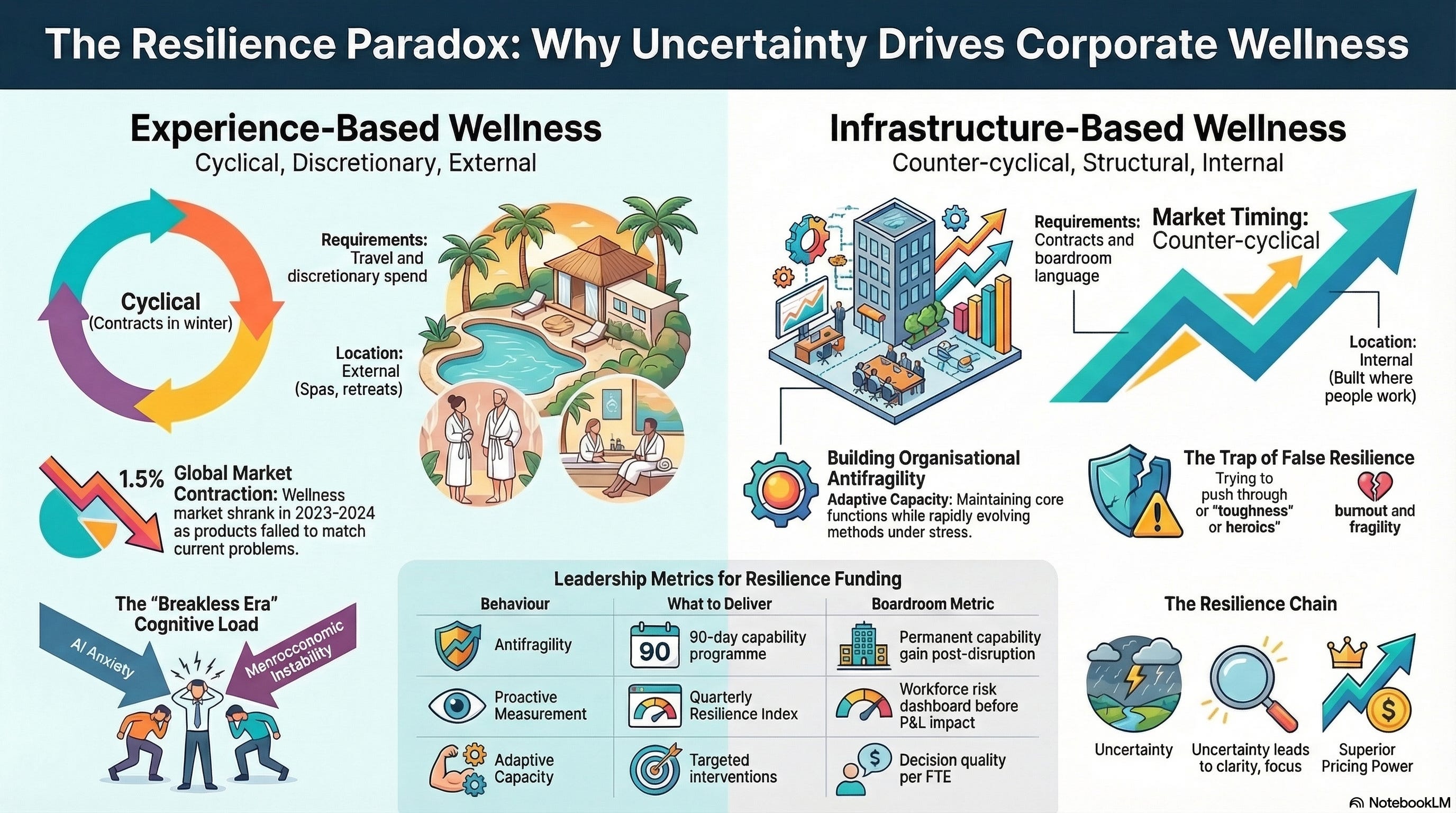
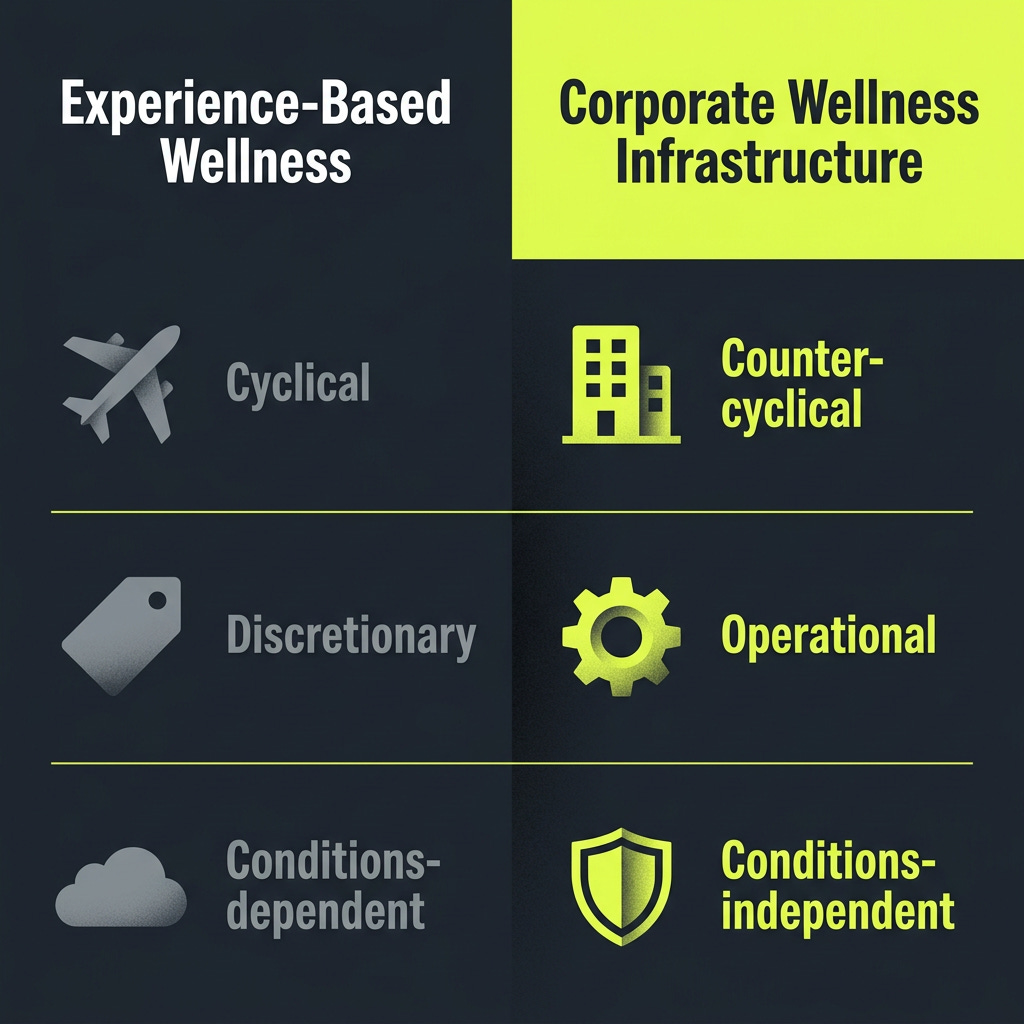
Two kinds of wellness businesses exist. Currently, one is struggling. The other is thriving.
The first sells experiences to people who travel to consume them: retreats, spas, and luxury longevity programs. When external shocks hit, economic disruption, regional instability, and discretionary travel contracts.
This business is cyclical by design.
The second builds wellness into the organizations where people already are.
It doesn’t need favorable conditions. It doesn’t need anyone to feel confident enough to book a flight.
It needs a contract, and a professional who can articulate why the investment makes business sense precisely because conditions are difficult.
When the world gets harder, the first business slows. The second accelerates.
The question is which one you’re building.
The Resilience Paradox
In my book The Evergreen Company, I write about what I call the Resilience Paradox: the companies that thrive in difficult periods aren’t the ones that avoid all difficulty. They’re the ones that use difficulty to become stronger.
They harvest lessons, relationships, and capabilities that their competitors simply cannot access in easy seasons.
The paradox is that less comfort can produce more advantage.
Competitors who try to return to normal miss the fact that disruption creates a new normal. The winners are the ones who learn fastest.
This is what separates organizations that emerge from difficult periods structurally stronger from those that simply endured them and went back to baseline.
And it is the exact argument that secures corporate wellness funding when every other discretionary budget is under review.
What uncertainty does to corporate budgets
The Global Wellness Institute’s Monthly Barometer for March 2026 frames the current environment with precision: a “breakless era”” where the speed of geopolitical change and AI disruption leaves no pause between one disruption and the next.
Two simultaneous cognitive loads are compressing workforce capacity right now.
The first is AI anxiety. The tech industry continuously signals disruption to white-collar work at a pace that creates ambient uncertainty even for people whose roles are not immediately at risk.
The second is macroeconomic instability. Energy prices, currency volatility, and restructuring cycles all generate a background layer of financial anxiety that degrades decision quality and focus.
Both loads are assigned to the same workforce. Simultaneously.
This is the operational problem arriving at the desk of every HR director and CFO in every major organization, in every market, right now.
Not a quarterly wellness program. A continuous state of elevated workforce pressure with no clear horizon.
The professionals who walk into that environment with a cognitive load management framework, a psychological safety infrastructure proposal, or a workforce resilience measurement system are solving a problem that has a documented financial cost.
The Global Wellness Institute’s 2025 Economy Monitor documented this at the market level
The global workplace wellness market shrank 1.5% last year. Not because companies stopped caring. Because the product was wrong. The professionals who figured that out are operating in a completely different budget.
The window, and why most professionals are missing it
Every time external pressure builds, a predictable pattern follows among wellness professionals: they go quiet. They read the headlines, sense the tension, and assume it is not the right moment to pitch.
It is precisely the moment to pitch!
The academic research on high-reliability organizations, the work of Sutcliffe, Vogus, Weick, and others, establishes that resilient organizations don’t achieve stability by waiting for conditions to improve. They achieve it through deliberate structural investment made during the disruption, not after it.
The organizations that come out of difficult periods with stronger teams, clearer decision-making, and lower attrition are the ones that treated the disruption as a design brief, not a period to endure.
That is the conversation you should be initiating right now. Not when things settle. Now.
Most wellness professionals are going quiet right now. The ones reading this far are not.
Below is the complete boardroom translation:
3 fundable resilience behaviors
What to measure for each one
The exact language that moves a wellness proposal from HR discretionary spending to the operational infrastructure budget.
Every other wellness publication covers the industry from the outside. This one is written from inside the boardroom. That is not a detail. That is the entire point.
For today and tomorrow only, the annual subscription is half price. One dollar a week.
The fully paid tier, permanently, for the price of a decision.
P.S This price does not stay.
Keep reading with a 7-day free trial
Subscribe to Wellness Intelligence to keep reading this post and get 7 days of free access to the full post archives.