
The wrong attitude about aging costs your workforce 7.5 years
What 11 countries found when they asked what wellness actually means

Hola amigos,
By the end of this brief, you will understand:
What 11 of the world’s leading aging researchers actually found when they asked what wellness means
Why a positive attitude about aging outperforms exercise, not smoking, and every step challenge ever run
What to do with this intelligence inside a corporate budget conversation
If you’re busy, save this and read it later. It’s worth the full 10 minutes.
1. The oldest people on earth never did a step challenge
The Global Wellness Institute just published a white paper. Eleven experts. Eleven countries — Japan, Indonesia, India, Australia, Canada, the UK, Singapore, Thailand, and the US. One question put to all of them:
What does aging well actually mean?
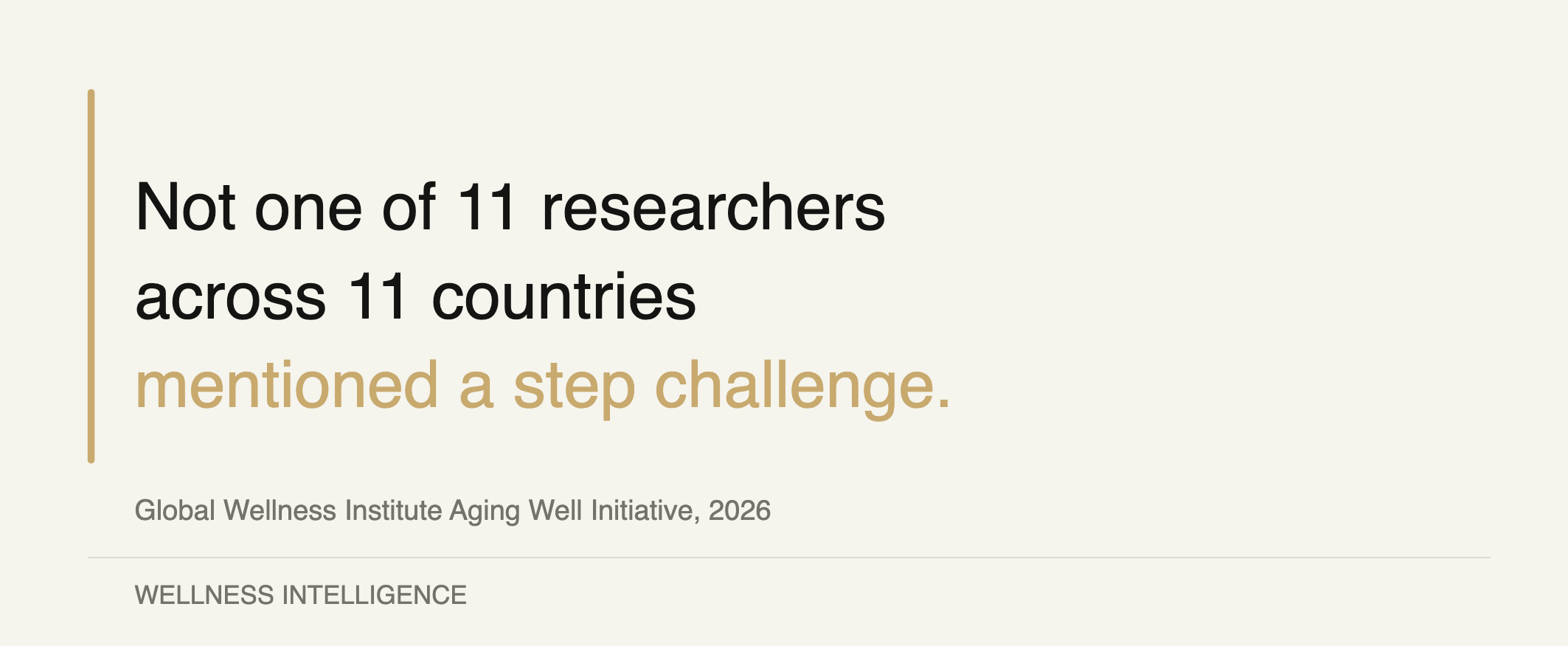
Not one of them mentioned a wellness app. Not one mentioned a biometric dashboard. Not one mentioned a step challenge.
What they described instead was specific, human, and — for anyone running a corporate wellness budget — deeply uncomfortable.
One man’s entire wellness strategy is perfecting his lawn. He is retired. He is thriving. He has not logged a single step. A researcher in Japan described men in their 60s re-forming their high school bands. An Indonesian researcher described aging well as simply being happy—having the freedom to socialize, travel, take small risks, and live in the moment.
The Japanese concept of ikigai surfaced across multiple interviews. It is often mistranslated in the West as a grand life purpose. The researchers were clear: ikigai means “my reason for getting up in the morning.” Not a goal. Not a metric. A reason.
2. The number that should end the step challenge conversation permanently
In 2002, Yale University researcher Dr. Becca Levy followed 660 people aged 50 and over for 23 years, tracking one variable: how they felt about getting older.
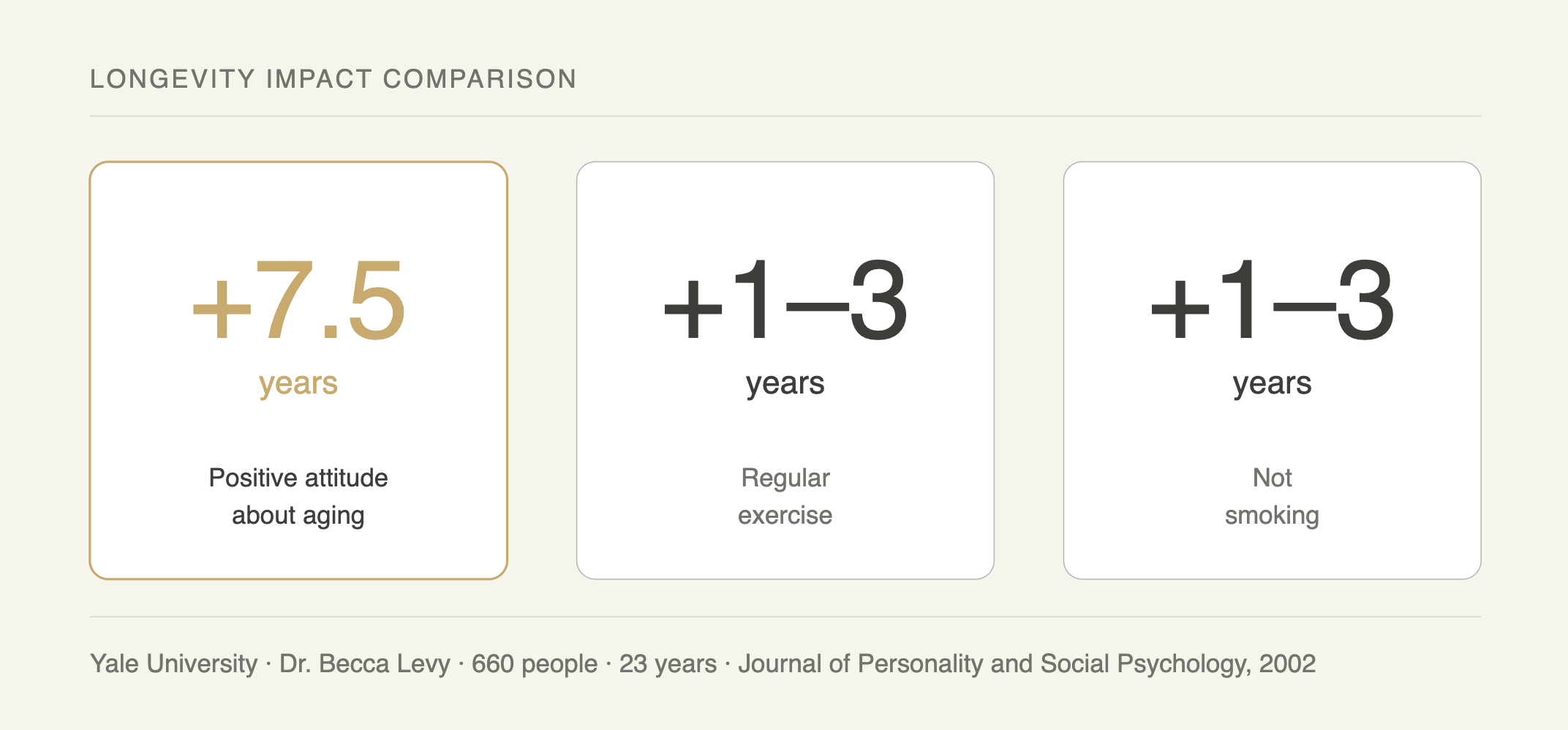
People with a positive attitude about aging lived 7.5 years longer than those with a negative one.
Not 7.5 months. 7.5 years.
The effect was greater than the longevity gained from low blood pressure. Greater than low cholesterol. Greater than maintaining a healthy weight, not smoking, or exercising regularly — each of which extends life by one to three years.
The single most powerful longevity intervention in the scientific literature is not physical. It is psychological. It is how your workforce thinks about getting older.
Source: Levy, B.R. et al. (2002). Journal of Personality and Social Psychology, Yale University.
3. What corporate wellness bought instead
The 2026 Global Wellness Summit Trends Report identified a formal backlash against the programs companies spent three years purchasing. The data is not ambiguous:
61% of employees now feel pressure to appear well even when they are not.
Source: Global Wellness Summit Trends Report 2026, citing Lululemon data.
More than half of the workforce inside organizations running wellness programs is performing wellness rather than experiencing it. The program designed to fix the problem has become part of it.
Meanwhile, the global workplace wellness market contracted 1.5% in 2023–2024. Source: Global Wellness Institute Economy Monitor 2025. Companies are not cutting wellness. They are cutting programs that do not work.
The gap between what the longevity research says and what corporate wellness budgets are buying is large. It is 7.5 years wide.
The inside version
Most Chief Wellness Officers present aging as a human story. That is why it stays in HR.
What follows is how I present it inside First Abu Dhabi Bank — as a risk story, with a financial frame, built on the research. This is the version that gets budgeted.
4. What the GWI experts actually said — the exact quotes
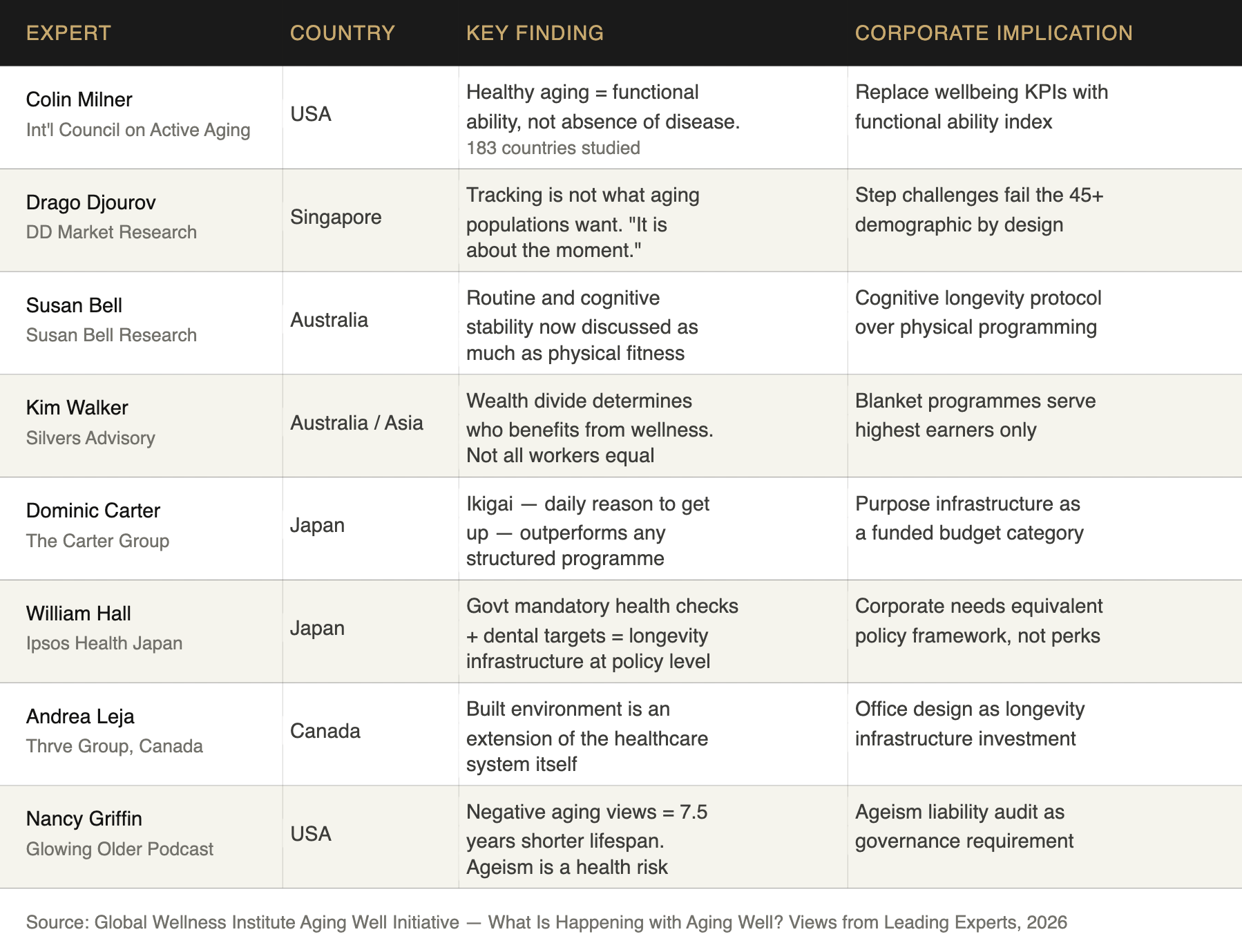
The Global Wellness Institute Aging Well Initiative interviewed 11 researchers across Japan, the US, the UK, Canada, Australia, Singapore, Indonesia, India, and Thailand. These are the findings that matter most for corporate positioning—with the exact words.
On what healthy aging actually means — and what corporate wellness is measuring instead:
Colin Milner, Chairman of the International Council on Active Aging, was the most precise expert in the report:
“The story of aging is being rewritten—as a narrative not of loss but of potential.”
His data point: the average American spends 12.4 years in poor health before they die. That is the widest gap between lifespan and healthspan of 183 countries studied. His argument — and the World Health Organization’s current position — is that healthy aging is not the absence of disease. It is functional ability: can you do what you want, when you want, with whom you want?
Most corporate wellness programs do not measure functional ability. They measure steps, sleep scores, and EAP utilization. Those are not the same thing.
On the tracking backlash—from the people closest to the data:
Drago Djourov, a Singapore-based researcher who spent two years studying aging populations across Japan and Asia, was direct:
“The preoccupation with tracking and quantifying every aspect of life is not the choice of older people. They are telling us: no, it is about the moment.”
This is not a generational preference. It is a consistent finding across 11 countries with radically different cultures, healthcare systems, and economic structures. Meaning, autonomy, and connection outperform measurement. Every time. In every country.
Regarding cognitive health as the primary aging variable:
Susan Bell, one of Australia’s leading retirement researchers, identified the shift that has the biggest corporate implication:
“The idea that routines are the key to staying cognitively solid is something we are seeing much more about. Mental stability and agility are now talked about as much as physical elements.”
Not step counts. Not VO2 max. Routine, stability, and cognitive agility. Those are the variables that predict healthy aging—and they are almost entirely absent from corporate wellness program design.
The wealth divide within your own workforce:
Kim Walker, a Bangkok-based adviser who spent decades studying aging across Asia, named the variable most corporate wellness strategies ignore entirely:
“The wealth divide is critical. Health is fundamental to aging well—but how much change is often an economic factor.”
The implication: the wellness outcomes of your workforce are not uniform. They are stratified by income. A blanket step challenge program serves your highest earners and misses almost everyone else. If your wellness strategy does not account for economic stratification, it is not a strategy. It is a benefit for the people who least need it.
On what purpose actually means — the finding most organizations have never acted on:
Dominic Carter, an Australian entrepreneur with 20 years in Japan, described the concept that surfaced in every country studied:
“In exploring what ‘living best’ means, we discovered it means finding joy in the details and modest ingenuity to enjoy life.”
His example is the one I used in this issue’s carousel: a retired neighbor whose entire wellness strategy is perfecting his lawn. The Japanese concept behind it—Ikigai—is not a grand life mission. It is a daily reason to get up. Researchers across 11 countries found versions of this same idea. That is the intervention most corporate wellness budgets have never funded. That is also the one with the strongest evidence base.
Download the full report here: GWI Aging Well Initiative — Views from Leading Experts →
Read Milner’s section on functional ability and Djourov’s section on what aging populations actually want. Those two alone will reframe how you think about your current program.
5. Three boardroom reframes — with exact language
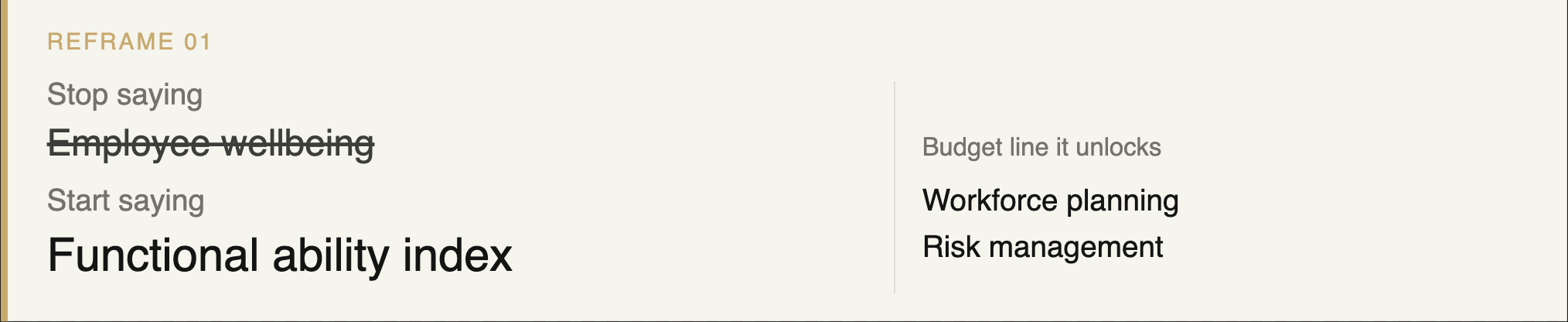
Reframe 1: Stop saying “employee wellbeing." Say “functional ability index.”
The WHO now defines healthy aging as functional ability, rather than the absence of disease, step count, or sleep score. Functional ability: can your workforce do what it needs to do, at the level it needs to do it, for as long as the organization needs it to?
That is a measurable, auditable, board-reportable metric. Employee wellbeing is not.
Exact language for a budget meeting:
“We are proposing to establish a functional ability baseline across our workforce. The World Health Organization defines healthy aging by this metric, not disease markers or fitness scores. We will track it annually. Decline in functional ability precedes absenteeism, medical claims, and productivity loss by an average of 18 to 24 months. This is an early warning system. Not a wellness program”
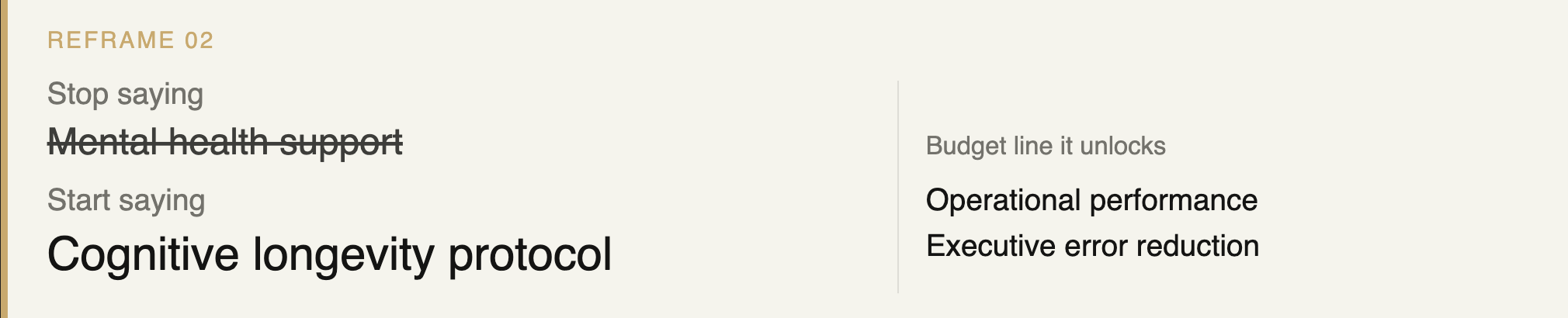
Reframe 2: Stop saying “mental health support.” Say “cognitive longevity protocol.”
The research is specific: routine, mental stability, and purposeful engagement are the primary drivers of cognitive resilience in aging populations. Early cognitive impairment reduces productivity and increases error rates before it is ever formally diagnosed, typically by two to three years.
A cognitive longevity protocol addresses that window. It is not counseling. It is infrastructure.
Exact language:
“We are seeing early indicators of cognitive load increase across our 45-plus demographic, longer decision cycles, higher error rates in complex tasks, and reduced capacity for ambiguity. These are documented precursors to formal cognitive decline. We are proposing a cognitive longevity protocol addressing the three evidence-based drivers: routine stability, purposeful engagement, and social connection. Cost: [X]. Estimated productivity protection value: [Y]. These are not comparable numbers.”
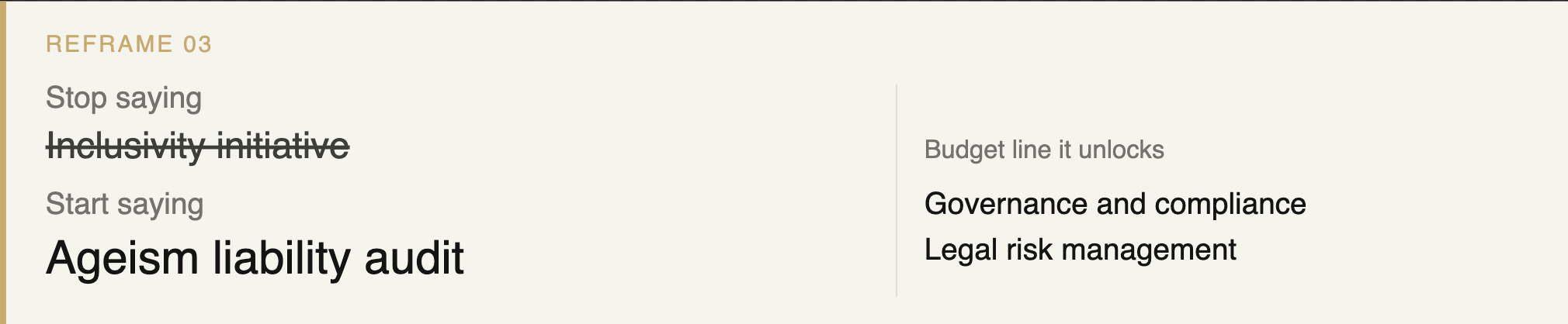
Reframe 3: Stop saying “inclusivity initiative.” Say “ageism liability audit.”
This is the most powerful budget unlock in this entire report — and almost nobody is using it.
The research is unambiguous: negative age stereotypes held inside an organisation’s culture are associated with shorter telomere length in employees, a direct cellular marker of accelerated biological aging. Source: National Institutes of Health, PMC, 2016. That is not a cultural problem. That is a legal and operational liability with a measurable biological mechanism.
An ageism liability audit sits in governance, not HR. It belongs next to your gender pay gap audit, your DEI reporting, and your health and safety review.
Exact language:
“Our current governance framework does not include age equity as a formal audit category. Given the documented biological impact of workplace ageism on employee health outcomes, including accelerated cellular aging markers and the growing legal exposure in this area, we are recommending an ageism liability audit as a Q3 governance priority. This is not a cultural initiative. It is a risk management requirement.”
6. Three AI prompts (copy-paste ready)
Prompt 1 — Functional ability business case: “I am presenting a wellness budget proposal to a CFO at a [financial services / healthcare / professional services] organisation with [X] employees, median age [X]. Build me a one-page business case for establishing a workforce functional ability index, using the WHO definition of healthy aging as functional ability rather than disease absence. Include: the cost of undetected functional decline, the measurement methodology, and the ROI calculation framework. Use risk management language throughout. Do not use the words wellness, wellbeing, or mindfulness anywhere in the document.”
Prompt 2 — Cognitive longevity protocol proposal: “Write a two-paragraph executive summary for a cognitive longevity protocol targeting employees aged 45 and over in a [sector] organisation. The scientific basis is: (1) routine and mental stability as primary drivers of cognitive resilience in aging populations, (2) purposeful engagement reducing dementia risk, (3) social connection as a longevity predictor stronger than exercise, per Yale University research. Frame it as workforce planning risk mitigation, not employee wellness. Include one measurable outcome for each of the three pillars. The tone should match a risk management brief, not an HR memo.”
Prompt 3 — Ageism liability audit scope: “Draft the scope of work for an ageism liability audit for a [sector] organisation with [X] employees across [X] locations. Structure it as: (1) legal exposure assessment, (2) cultural audit methodology, (3) environmental review — does the physical workspace signal age bias?, (4) policy review — do performance management, promotion, and redundancy processes contain age-correlated patterns?, (5) remediation framework. Output should read as a governance document, not an HR initiative. Include two measurable KPIs per section.”
7. The takeaway
The research did not find that step challenges are ineffective. It found something worse: they are measuring the wrong thing entirely.
Functional ability. Cognitive resilience. A reason to get up in the morning.
Those are the outcomes your workforce needs and the outcomes your organization can fund — if you use the right language.
The professionals who make that translation first are not entering a crowded space. They are entering a near-empty one.
Full report download: GWI Aging Well Initiative — Views from Leading Experts →
Hasta la vista, amigos!
Diego Carrete
Chief Wellness Officer, First Abu Dhabi Bank Global
Wellness Institute Ambassador
Founder, Wellness Intelligence
If this issue gave you something useful, consider gifting a subscription to a colleague who needs it. Wellness Intelligence — less than 1 AED a day.
Sources:
Global Wellness Institute Aging Well Initiative: What’s Happening with Aging Well? Views from Leading Experts. 2026.
Levy, B.R. et al. (2002). Longevity increased by positive self-perceptions of aging. Journal of Personality and Social Psychology, 83(2). Yale University.
Global Wellness Summit Trends Report 2026. Lululemon's workforce well-being data.
Global Wellness Institute Economy Monitor 2025. Workplace wellness market contraction data.
National Institutes of Health/ PMC (2016). Negative age stereotypes’ association with accelerated cellular aging.
World Health Organization (2016). Discrimination and negative attitudes about aging are bad for your health.