
The pipeline that replaces a consultancy research team
The AI workflow for the wellness professionals who want to break into corporate


Hola amigos,
Como estais?
It is 6:12 AM. I am at the kitchen table with coffee, the house still asleep, a laptop open, and a tab of Claude running in the background.
In the next 40 minutes, before my kids wake up, I will have screened three organizations, identified the wellness gaps visible in their own reporting, and mapped where the budget actually sits.
I am not doing this exercise to pitch them.
I am a Chief Wellness Officer at the largest bank in the Middle East. I sit on the buying side of the table. This is the workflow I run to brief my board, evaluate the wellness market, and assess the hundreds of vendors who pitch me every year.
Which is exactly why I am sharing it.
Because if you reverse-engineer the pipeline a CWO uses to evaluate the market, it becomes the pipeline you would run to pitch a CWO.
A week ago, I told you I had found three corporate wellness opportunities before breakfast, and I promised to show you the pipeline.
This is that pipeline.
It is also the second issue of Wellness Intelligence — AI, a new monthly edition inside this publication.
One issue per month is dedicated to the AI workflows that let a solo wellness professional operate with the leverage of an agency.
The first three steps are free, below.
By the end of this brief, you will have:
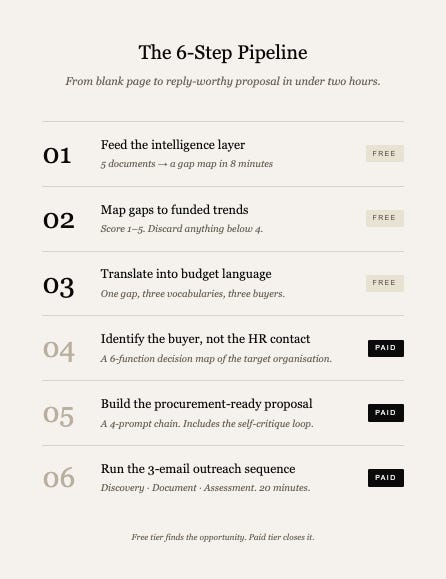
The 6-step pipeline I run every week as a CWO
The exact document inputs and prompt architecture for the first 3 steps
How buyers identify other buyers, the proposal structure that survives procurement, and the 3-email sequence that gets a CEO like me to reply
Why this matters now
I read every wellness proposal that lands in my inbox.
Most of them do not make it to the second paragraph.
The work is often excellent.
The proposal fails for three reasons that have nothing to do with the wellness protocol itself:
The professional pitched the wrong person inside the company.
The proposal was written in wellness language, not budget language.
The ROI section read like a vendor brochure, not a finance document.
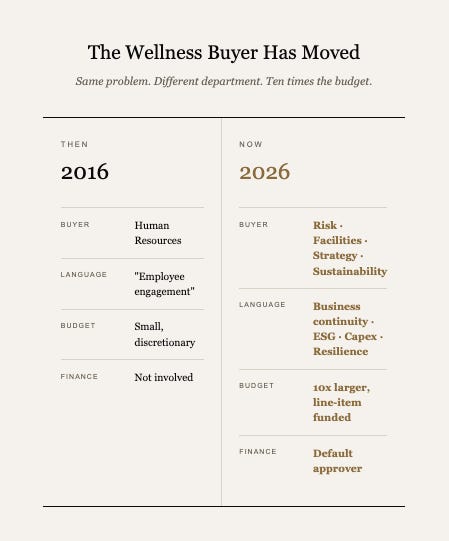
Ten years ago the wellness buyer was HR and “employee engagement” was the vocabulary. The budget was small, and nobody on the finance side cared.
In 2026 the buyer is increasingly Risk, Facilities, Strategy, or Sustainability. The vocabulary is business continuity, ESG, capex, and workforce resilience. The budget is an order of magnitude larger.
And here is what almost no one in our industry has caught up to:
The intelligence you need to find those buyers is now publicly available. It just requires the right pipeline to surface it.
AI is that pipeline.
Step 1 — Feed the intelligence layer
When I evaluate a vendor, or when I assess a peer organisation’s wellness position, I start with their own documents.
I feed five of them into Claude:
The latest annual report
The ESG or sustainability report
The most recent investor presentation
Glassdoor reviews from the last 18 months
The current GWI Economy Monitor and GWS 2026 Trends Report
The prompt is simple:
“You are an analyst preparing a wellness market-entry brief. Based on the documents provided, identify the top 5 wellness-relevant gaps that appear consistently across this company’s own reporting and its public employee feedback. For each gap, cite the exact source.”
In 8 minutes, I have a gap map that used to take a consultancy 2 weeks.
The company has told me what is wrong. The employees have confirmed it. The only thing missing is the translation, which happens in the next step.
Step 2 — Map gaps to funded trends
A gap without a funded trend behind it is a volunteer project.
I take the 5 gaps from Step 1 and cross-reference them against the 5 trends I wrote about in April—the ones the Global Wellness Summit named as the next wave of corporate budget movement:
Readiness (business continuity)
Festivalization of wellness (high-touch group experience)
Microplastics as a human health issue
Longevity residences (the built environment)
Social media’s Big Tobacco moment
The prompt:
“For each of the 5 gaps identified, score its alignment against these 5 funded trends on a scale of 1-5. For any gap scoring 4 or above, draft a one-sentence thesis for why this company would fund an intervention in 2026.”
Anything scoring 3 or below is discarded. Budgets do not exist yet for those gaps.
What is left is a shortlist of 2–3 gaps where the company has a visible problem and the market has a funded solution category.
Step 3 — Translate into budget language
This stage is the step most wellness professionals never take, and it is the one that decides whether a proposal ever reaches my desk.
A gap described as “employees are burned out” is an HR complaint.
The same gap described as “workforce continuity risk resulting from sustained cognitive load, measurable against business continuity thresholds” is a line item on a risk register.
Same problem. Different buyer. 10x the budget.
I run a third prompt:
“For each shortlisted gap, rewrite it in three different vocabularies: (1) business continuity and risk management, (2) ESG and sustainability reporting, (3) capex vs opex classification. For each version, name the function inside a company that owns that budget.”
The output is a translation matrix.
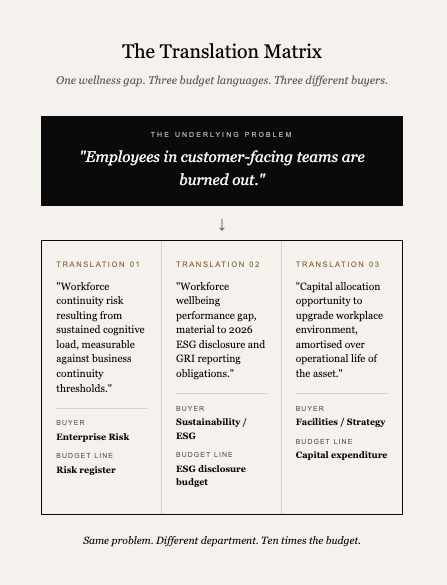
Same wellness gap, expressed in three budget languages, each pointing at a different buyer.
At this point I have done in 40 minutes what a consultancy would deliver in a 3-week engagement and charge $40,000 for.
For paid subscribers, below is:
Step 4 — How do buyers identify other buyers. The prompt I use to map any organisation’s wellness decision-makers across 6 functions.
Step 5 — The procurement-ready proposal chain. The 4-prompt sequence that produces a 1-page executive summary, a 3-page proposal with KPIs tied to business outcomes, and a finance-ready ROI projection.
Step 6 — the 3-email outreach sequence that gets me to reply. Discovery request, document-referenced follow-up, free assessment offer.
See you inside.
Keep reading with a 7-day free trial
Subscribe to Wellness Intelligence to keep reading this post and get 7 days of free access to the full post archives.