
The 5 wellness trends moving real money in 2026
And the countries where they’re already being funded

Hola amigos,
Como estais?
This weekend I played a quiet game with myself.
The rule was simple: be the most present father on earth for 48 hours.
I think I did ok.
And while I was putting my phone down, two reports landed that explain why the rest of the world is about to do the same.
The Global Wellness Summit published its 2026 Trends Report in January. The Global Wellness Institute released its updated Country Rankings shortly after.
Read separately, they are interesting.
Read together, they are a cheat code.
The trends tell you what is changing.
The country data tells you where the money has already moved to fund it.
Those of you who read both will know where to position before anyone else does.
By the end of this brief, you will have:
The five 2026 wellness trends most professionals are missing
The countries where the wellness economy is growing fastest right now
The budget language that translates each trend into a corporate offer
1. The first five trends are already priced in
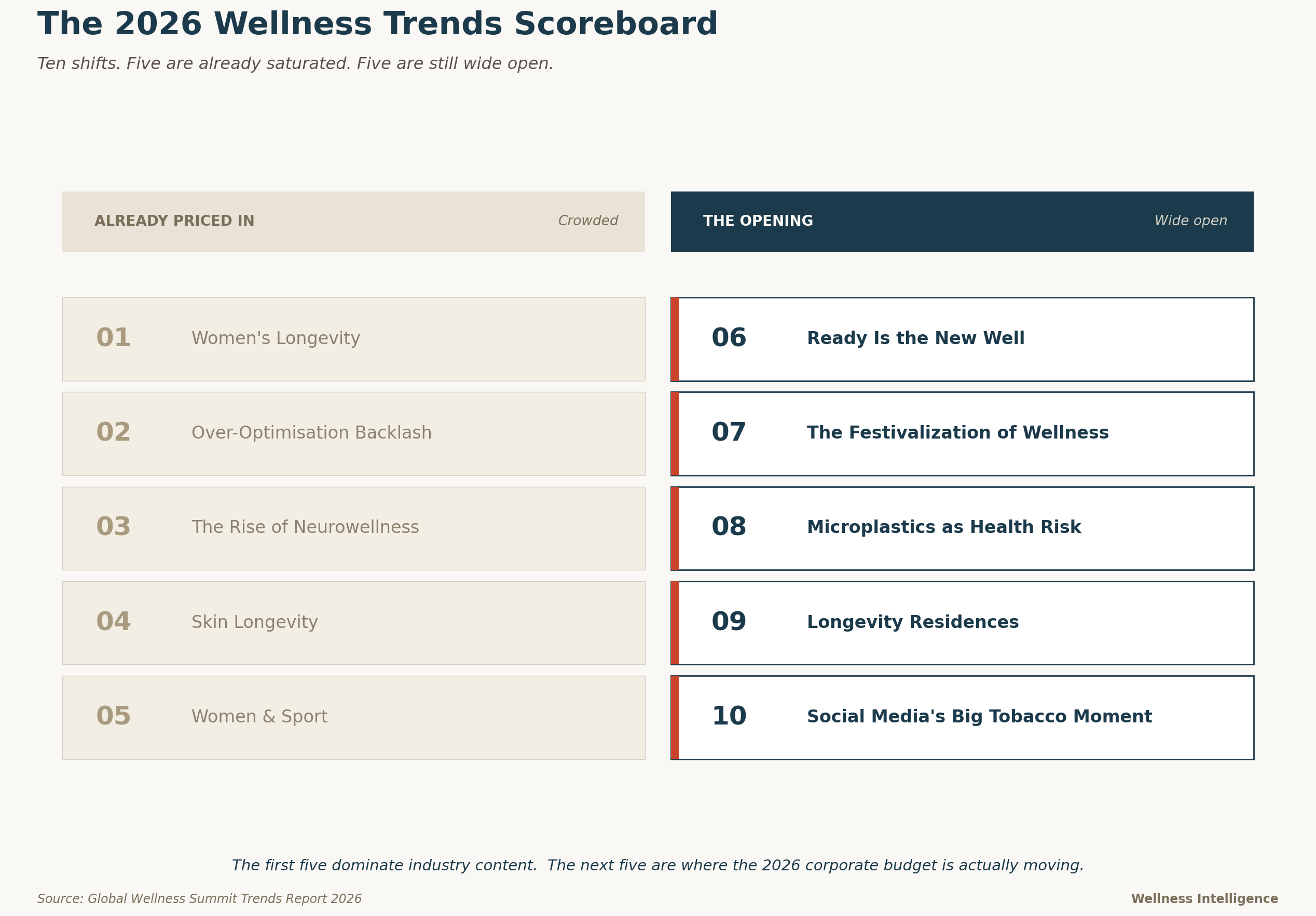
The 2026 Global Wellness Summit Trends Report named ten shifts that are shaping the industry this year.
The first five (women’s longevity, the over-optimization backlash, neurowellness, skin longevity, and women in sport) are already saturating the content you see every day.
The real opportunity for wellness professionals in 2026 is in the five trends nobody is positioning against yet.
Each one is named in the report.
Each one has a corporate budget implication.
And each one maps to a specific country where growth is already happening.
2. The five trends nobody is talking about yet
Trend #6 — Ready Is the New Well
Climate shocks, supply disruption, and geopolitical instability.
The 2026 report names “readiness” as a new category of preventative wellness, the idea that having a disaster plan is becoming as essential as having a fitness plan.
For corporate, this category is a new budget line entirely.
Organisational readiness — the capacity of a workforce to absorb shock and continue operating.
The professionals who can translate their work into business continuity language will access a budget no wellness provider is currently touching.
Trend #7 — The Festivalization of Wellness
The over-optimization backlash is producing its opposite.
Sober raves.
Breathwork ceremonies.
Cathartic group experiences.
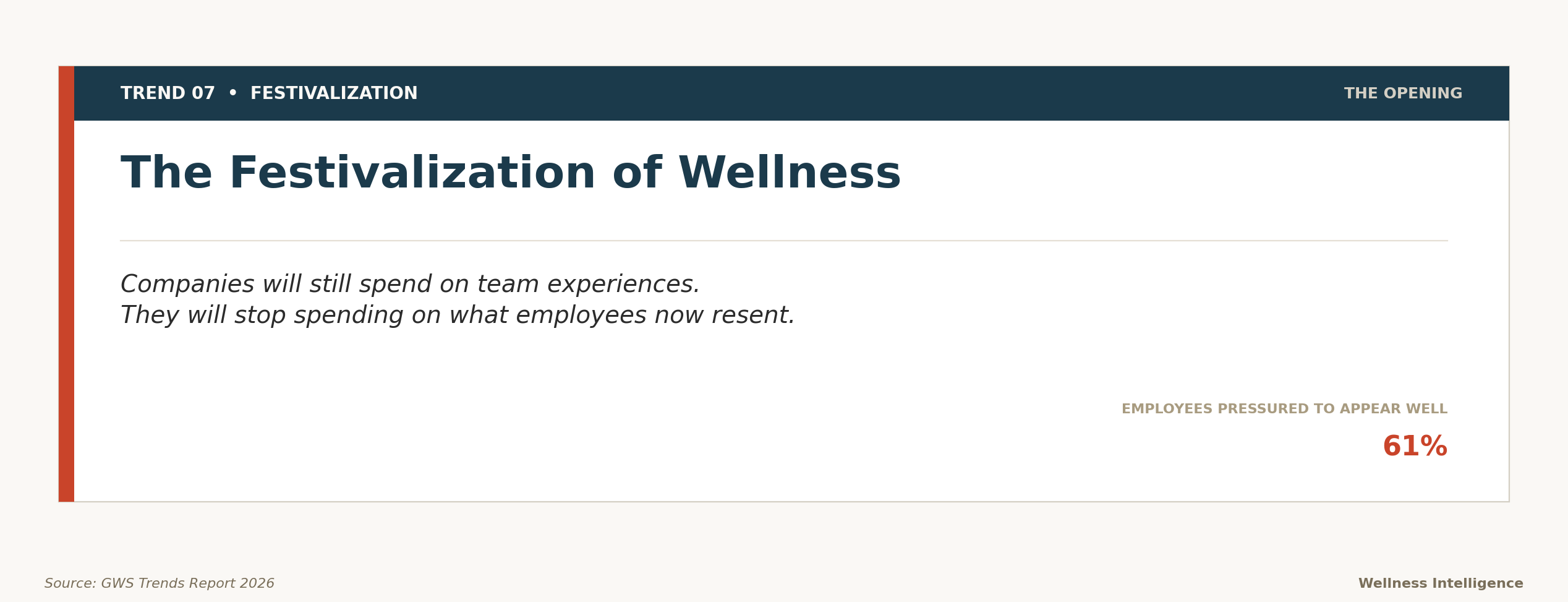
The 2026 report calls this the festivalization of wellness "The shift from tracked, measured, individual wellness to wild, collective, emotionally honest experiences.”
For corporations, this is the replacement product for step challenges and wearables.
Companies are still going to spend money on team experiences.
They are just going to stop spending it on the things employees now resent.
The opening: any professional who can design a high-touch, high-feeling group experience—with a measurable outcome attached—replaces the app-based program in the next procurement cycle.
Trend #8 — Microplastics as a Human Health Issue
Microplastics have now been detected in human blood, lungs, placentas, and brain tissue.
The research is linking exposure to inflammation, hormonal disruption, and cognitive effects.
The 2026 report marks this as the year the conversation moves from awareness to action.
For corporations, microplastics are an environmental health risk category that does not exist in most organizations yet.
Water systems, food services, packaging, indoor air.
Every one of these is a surface where a wellness professional can build protocol.
Trend #9 — Longevity Residences
Longevity is moving out of clinics and into the buildings we live and work in.
Preventive diagnostics, recovery rooms, AI-assisted health tracking, and environmental regulation built directly into residential and commercial properties.
This is the convergence of wellness, real estate, and corporate wellness, which no one in this industry is articulating clearly yet.
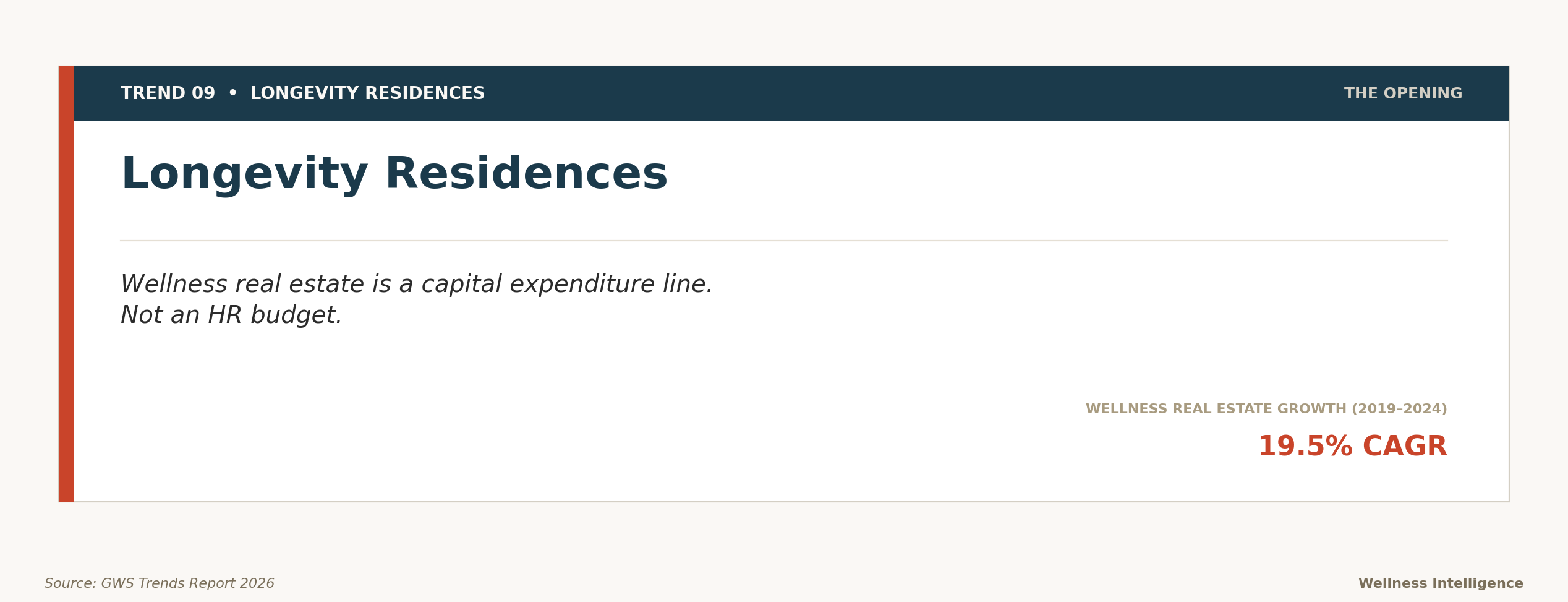
According to the Global Wellness Institute Economy Monitor 2025, wellness real estate grew 19.5% annually from 2019 to 2024 and will pass one trillion dollars by 2029.
The opening: professionals who can audit an office or residential development against longevity and wellness criteria are selling into a capital expenditure line, not an HR budget. That is an entirely different order of magnitude.
Trend #10 — Social Media’s Big Tobacco Moment
The Global Wellness Institute’s was explicit.
Social media is entering its big tobacco moment—the point where the scientific consensus on cognitive, mental, and physical harm reaches the mainstream, and the corporate and regulatory response follows.
3. You now know what is coming
The next question is where it is being funded.
A trend only matters if someone, somewhere, has a budget for it.
And the Global Wellness Institute’s 2026 Country Rankings—released this month—show exactly where the money is already moving.
One region is outperforming every other major market on earth.
One country jumped six places in the global rankings in five years.
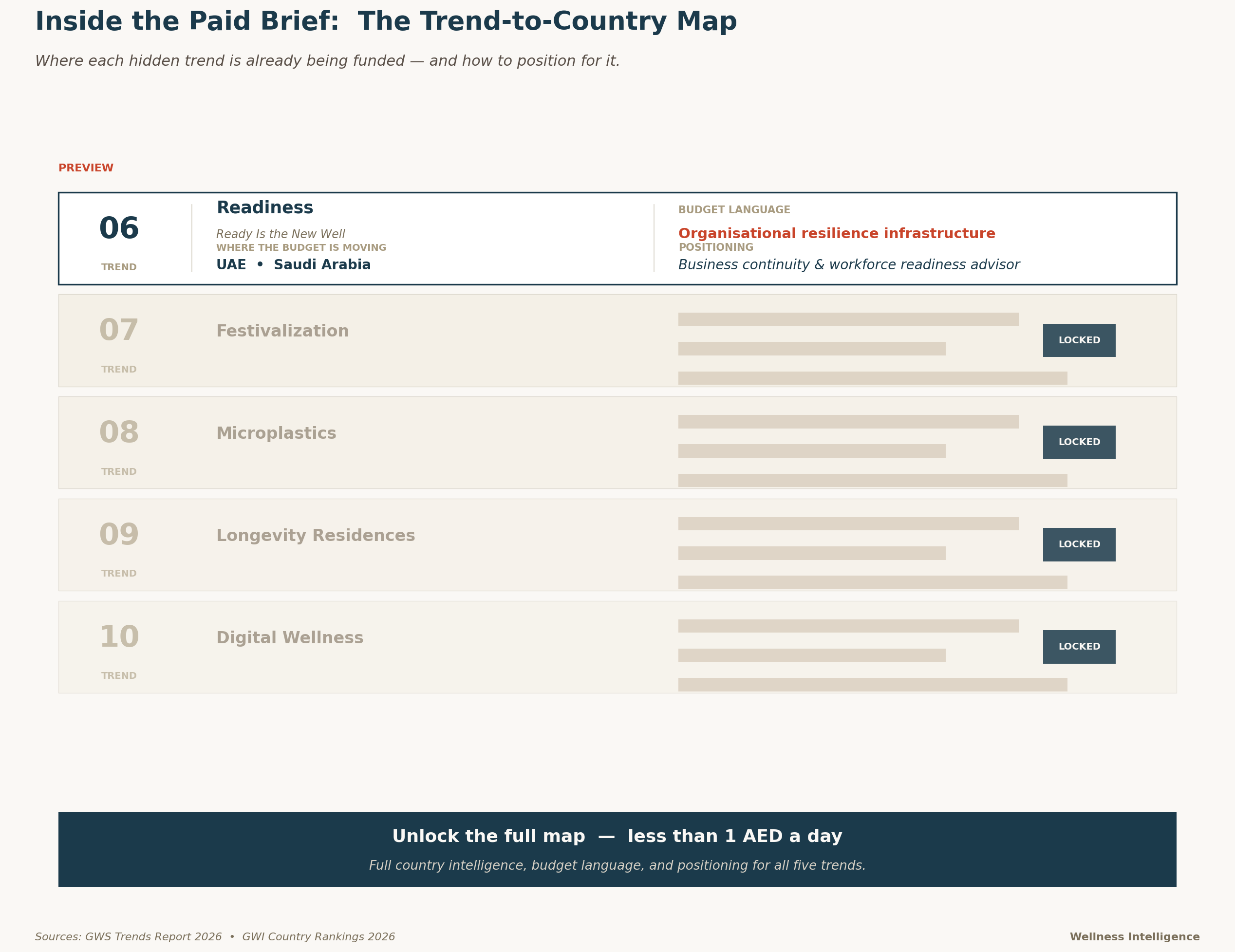
For Wellness Intelligence subscribers paying less than 1 AED a day, below is
The 6 fastest-growing wellness economies in the world
Why the UAE and Saudi Arabia are now the two most important markets in global wellness and what that means for professionals in or near the GCC
Which of the 5 trends maps to which country’s budget
Three AI prompts you can use this week to build irresistible corporate offers
See you inside!
Keep reading with a 7-day free trial
Subscribe to Wellness Intelligence to keep reading this post and get 7 days of free access to the full post archives.