
If you work in wellness, something shifted 6 weeks ago
Two industry reports landed the same week. They say one thing

Hola amigos,
Como estais?
Before we begin, here is what you will learn by the end of this email:
Why the value of wellness has increased in the past six weeks
What “Readiness” means as a wellness category
Why it is the most undercrowded opportunity in the market today
How to access the budget before everyone else
1. The six-week shift
Something has changed in the past six weeks that most have not yet noticed.
In January 2026, the GWS published the most authoritative document in the industry, built from the insights of hundreds of CEOs who gather once a year to map where the market is going.
Last month, the GWS published its Monthly Barometer, a private intelligence briefing that lands in the inboxes of a small group of researchers. My inbox was one of the lucky ones.
Read together, they tell a single story.
The world became measurably more unstable over the past six weeks. And when the world becomes more unstable, two things happen simultaneously.
The wellness economy grows faster.
The nature of what organisations need from wellness professionals changes.
The wellness economy is already projected to grow at 7.6% annually from 2024 to 2029 but right now, the market is moving even faster toward you.
The question is whether you are ready to meet it.
2. The six-week data
Let me be specific about what changed, because specificity is what makes this information useful.
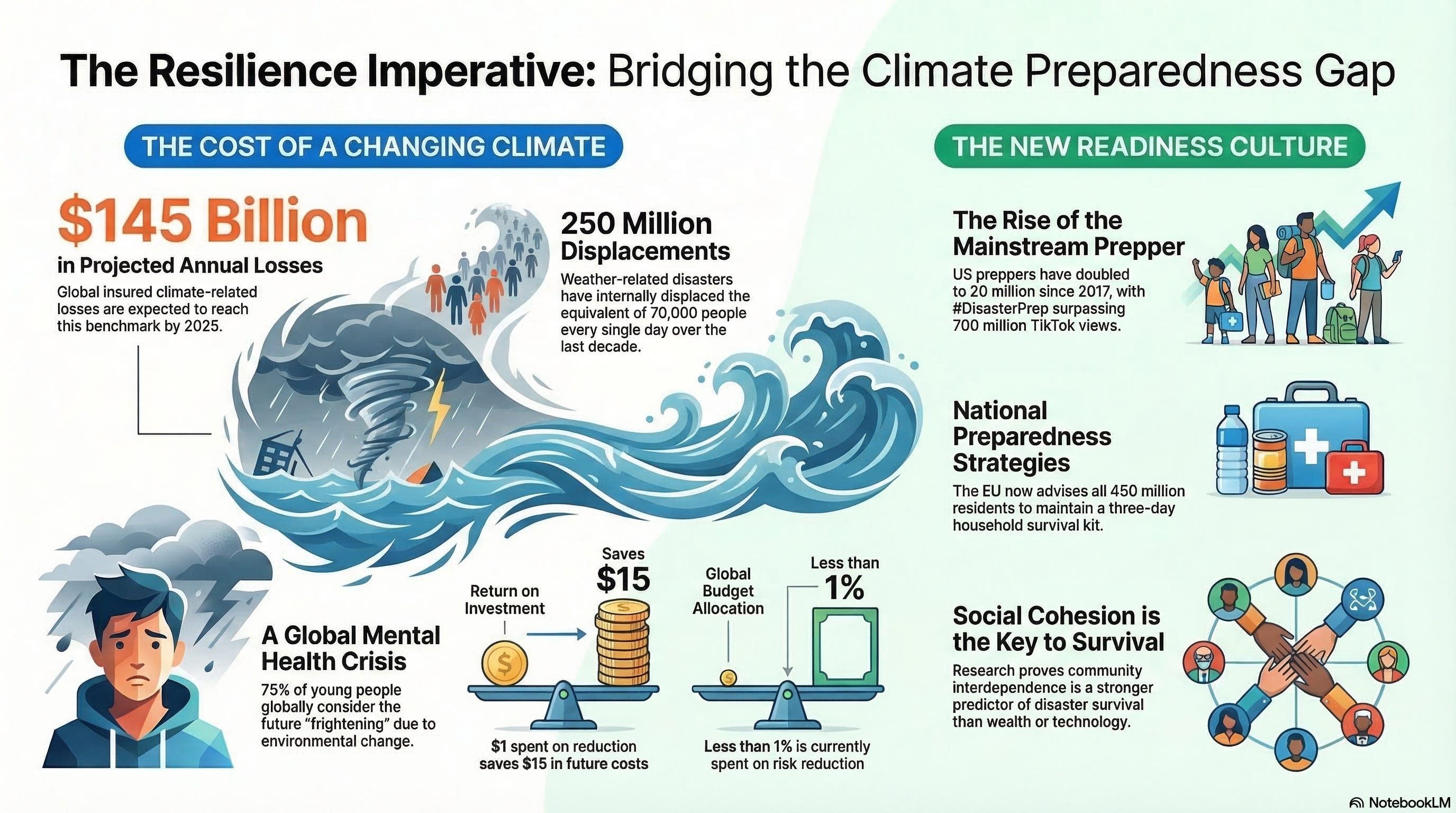
The climate loss number: 2024 set a grim benchmark, with 151 climate disasters globally. Industry analysts project 2025’s insured climate-related losses will reach approximately $145 billion.
The mental health number: A global survey by the University of Bath found that 75% of young people consider the future “frightening” while nearly half say climate anxiety affects their daily functioning.
The displacement number: Over the past 10 years, weather-related disasters have caused approximately 250 million internal displacements equivalent to 70,000 displacements per day. Climate change is projected to cause 250,000 additional deaths annually from 2030 to 2050.
The preparedness gap: Studies indicate that every $1 spent on disaster risk reduction delivers an average return of $15 in averted future costs. Despite this, less than 1% of public budgets globally are allocated to disaster risk reduction.
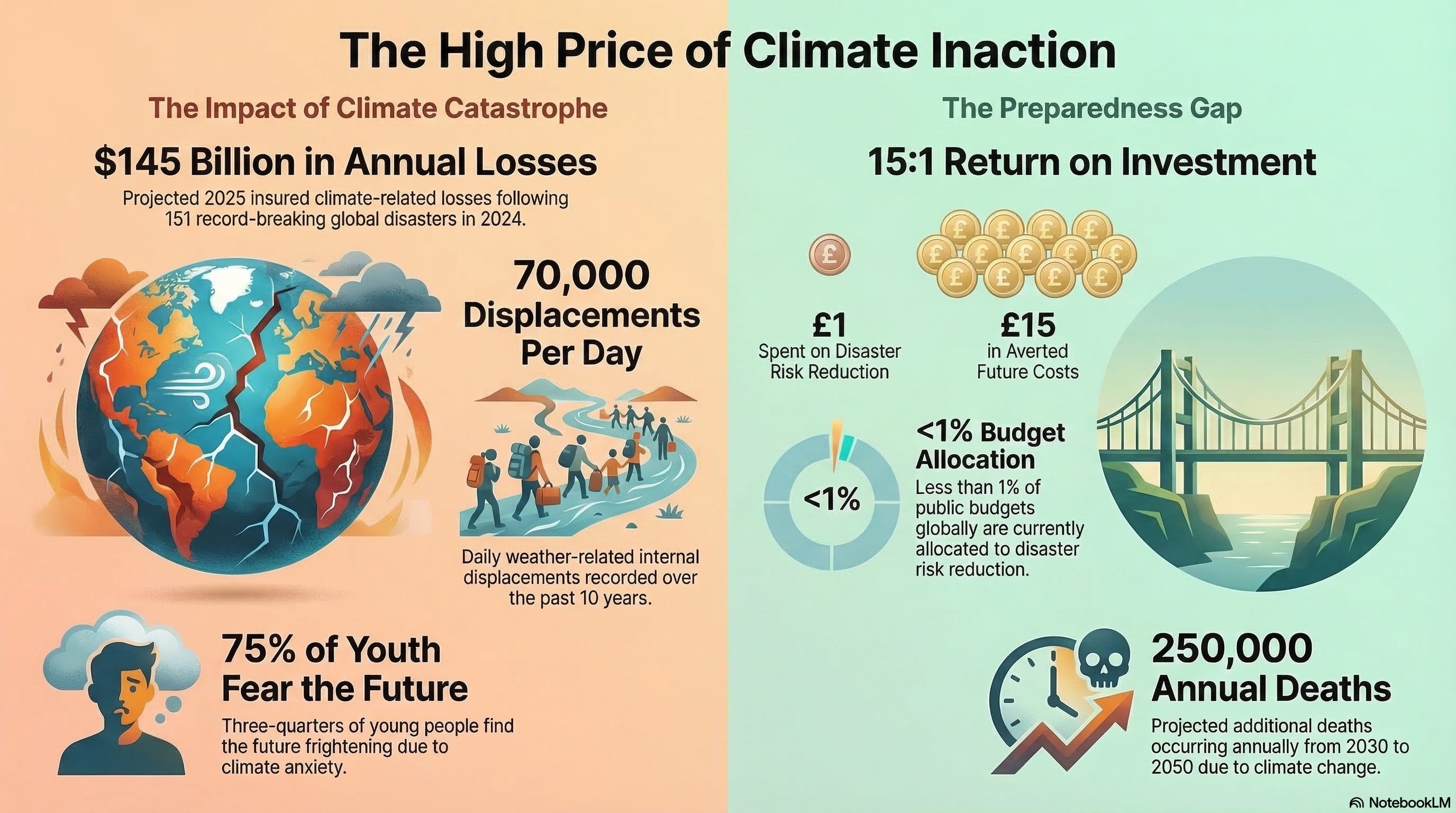
The wellness professionals who can connect their work to these numbers are sitting in a different budget conversation than those who cannot.
3. Ready Is the New Well
The GWS named it in their 2026 trends report: Ready Is the New Well.
If wellness has always promised protection (from disease and from burnout), the next wave of wellness promises something different…
Survival itself.
The GWS describes readiness not as a niche concern for survivalists but as the next evolution of preventive care. Just as preventive medicine transformed healthcare, disaster readiness is becoming the next evolution of everyday resilience.
Three pillars define it:
Mental resilience: the psychology of being ready.
Eco-anxiety was officially recognized as a public health concern by the World Health Organization in 2022. The emotional distress caused by environmental change is now a clinical category.
After the 2025 Los Angeles wildfires, Headspace offered free subscriptions to all LA County residents as part of the region’s official recovery resources, positioning nervous system regulation as an essential coping tool.Physical readiness: from prepping to preventive care.
- Self-identified preppers in the US have doubled to over 20 million people.
- The hashtag #DisasterPrep has surpassed 700 million views on TikTok, transforming practical preparedness into mainstream lifestyle content.
- Wellness real estate is shifting toward climate-adaptive design.
- The EU launched its Preparedness Union Strategy in March 2025, advising all 450 million residents to stock a three-day household survival kit.Community interdependence: resilience as a collective activity.
Research proves that social cohesion is the strongest predictor of post-disaster survival. The organisations investing in genuine community and team cohesion are building something that matters in a way that EAPs never could.
For Wellness Intelligence private subscribers (they pay less than 1 AED a day)
— The exact words to use when pitching “Readiness” to a company (not wellness language, the language that gets a budget approved)
— Which types of organisations in the GCC are already spending on this, and who specifically to approach
— How to turn each of the three pillars above into a paid project
Everything above is the why. Everything below is how to put it into practice.
Keep reading with a 7-day free trial
Subscribe to Wellness Intelligence to keep reading this post and get 7 days of free access to the full post archives.