
I reviewed 23 wellness proposals. None were funding-ready
I translated all 23 into the buyer's language


Hola amigos,
It’s 4:32am. Three days post-procedure.
I can only lie on my back, and to be honest, resting my head on the pillow is painful.
But on the positive side, I stopped by McDonald’s and bought a black coffee for $1.5.
That’s a 75% discount on what the same cup costs anywhere else here.
I’ve spent the time from 4:30 to 7:00 this week translating wellness proposals that I’ve received this quarter.
Guess what.
None of the proposals were funding-ready in their current form.
They were excellent though, but had a vocabulary problem.
By the end of today, you’ll understand:
why those 23 proposals all failed the same translation test
what the four current languages actually sound like—in a deck, on a website, in a pitch
the single rewrite that moves an offer from invisible to under review
Access to my Proposal GPT (yes, it will do the heavy lifting for you!)
Vamos a por ello!
The market changed. The pitches didn’t.
Last issue named the architectural shift in the Global Wellness Institute (GWI) 2026 report: nervous system regulation, functional longevity, built environment as health infrastructure, and social connection as a clinical variable.
Four currents are tied to one economic shift.
The reaction I got from paid subscribers in the 72 hours after publication was almost identical, in seven different inboxes:
“I see the shift. I need help rewriting my offer.”
The wellness real estate sector is now $548.4 billion, growing at 19.5% CAGR (GWI Wellness Economy Monitor 2025).
Workplace wellbeing is on track to clear $94 billion by 2027.
Mental wellness sits at $268.3 billion.
The dollars are moving. That’s data.
The language used to access them is still outdated, both in the practitioner pitch decks I see and in the approved procurement categories.
The reason most pitches stall is not that the buyer disagrees with wellness.
The buyer actually agrees with wellness.
However, the buyer cannot justify the term “wellness” during a budget meeting with their managers or board.
The buyer can, however, defend nervous system regulation infrastructure and readiness.
Why?
Because it stops being an abstract, good-willed concept into a trackable mechanism.
There is a measurable capacity
An internal owner
A procurement category
An item in next year’s risk register.
That is what translation actually is.
Not synonyms.
A structure that can defend a buying decision.
Translation, in two examples
Example 1 — The mindfulness coach
Old offer: “Mindfulness coaching to reduce employee stress.”
Translated offer: “Cognitive resilience program with recovery monitoring, delivered as an intervention for client-facing teams during high-volume cycles.”
What changed: the deliverable is now measurable (recovery time), the buyer is now the head of operations or a CHRO defending workforce risk, and the line item moves from a discretionary perks budget to a workforce continuity expense.
The mindfulness has not gone anywhere.
The coaching has not changed.
The session structure can be identical.
The procurement category is what has moved.
Example 2 — The ergonomics consultant
Old offer: “Ergonomic assessments to reduce back injury claims.”
Translated offer: “Built environment as health infrastructure—circadian lighting, neuroarchitecture, and movement-permitting layouts, scoped against absenteeism and benefits-utilization data.”
What changed: the buyer is now the head of real estate or facilities, not HR. The pitch reads as capital expense planning, not a wellness perk. The metric is no longer “did the assessment happen” but “did absenteeism shift in the lit zone versus the unlit zone.”
The consultant’s expertise is unchanged.
The buyer is different.
The budget category is different.
The invoice is bigger.
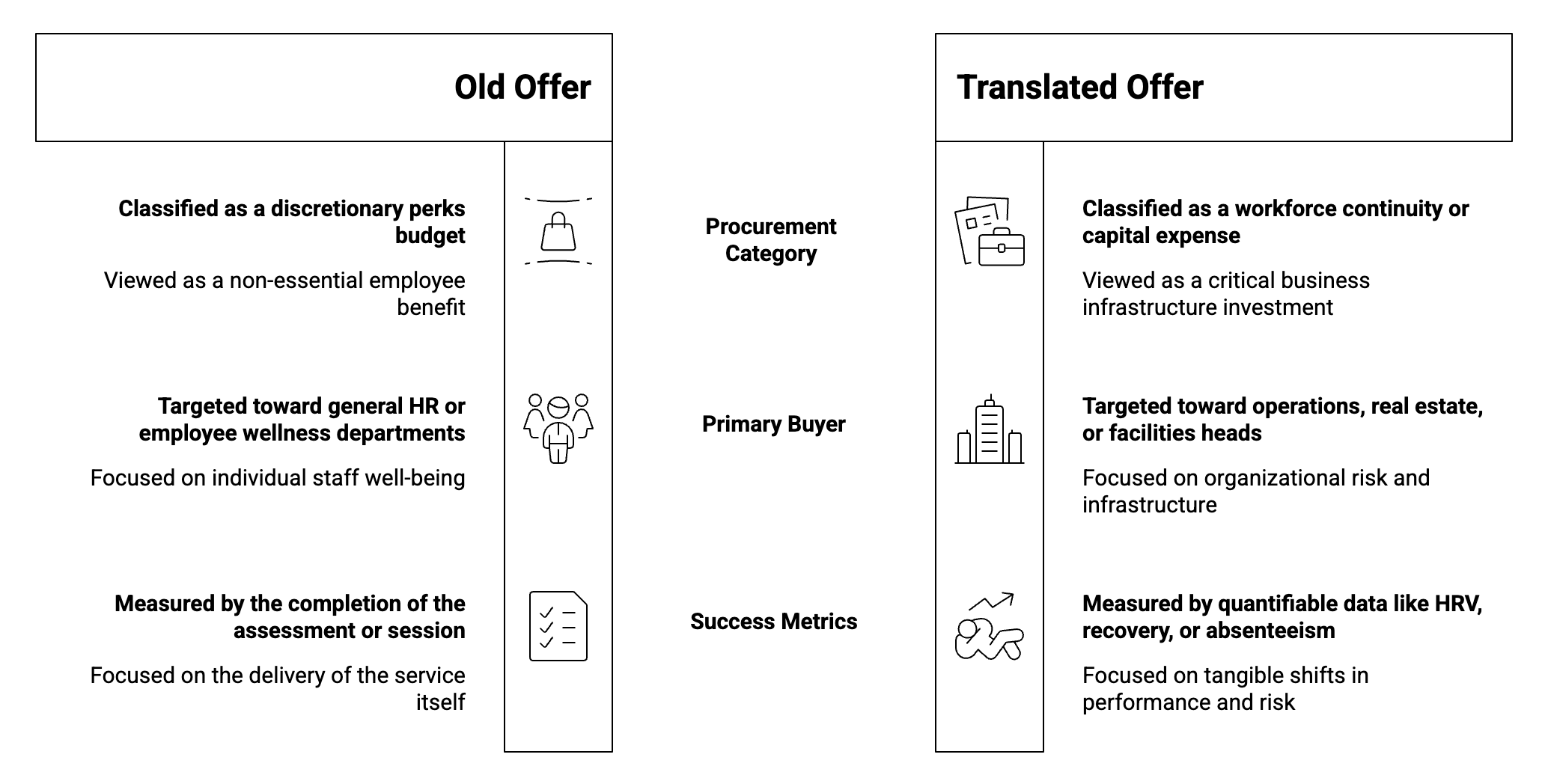
The pattern
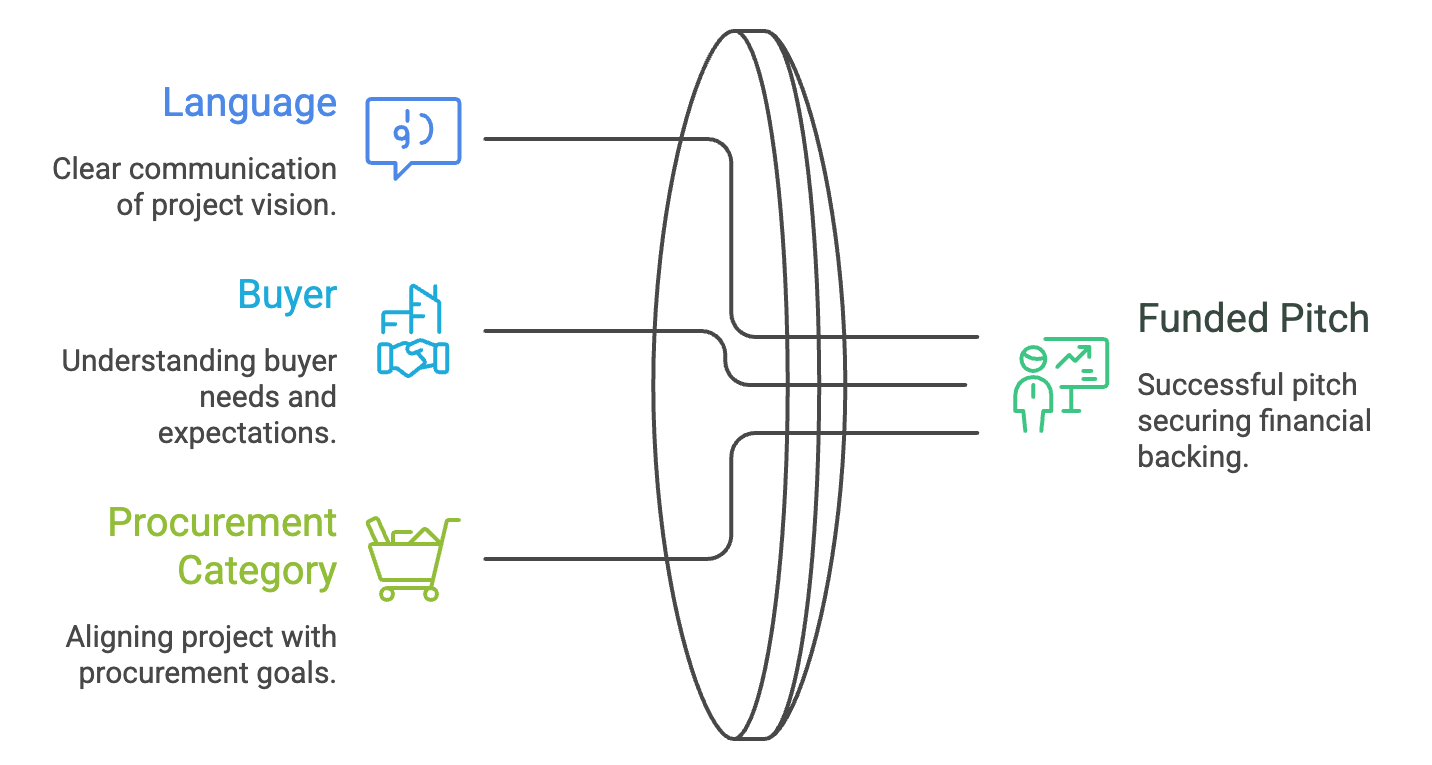
In every translation that lands, three things change at once:
The language
The buyer inside the company
The procurement category.
Move only one and the pitch still stalls.
Move all three, and the pitch lands in a meeting where it can be approved.
This is what the previous newsletter meant by “different language, different ROI, and different invoice.”
Same offer.
Three structural moves.
The question you’re asking right now is: what does my exact offer translate to?
That’s the matrix below:
Twenty-plus practitioner categories rewritten in 2026 buyer language, with the buyer, the metric, and the procurement category named for each.
Furthermore, the Boardroom Proposal GPT is a custom GPT that runs five minutes of discovery on your buyer, then writes back an eleven-section corporate wellness proposal with the ROI math shown and sources cited live.
Less than 1 AED a day (yearly) — for the next 20 paid subscribers.
At subscriber #21, the rate goes up and stays up.
It will double.