
How to turn Workplace Design into paid wellness work
A new business model worth exploring this week

Hola amigos,
Como estais?
Before we begin, here's a quick fact.
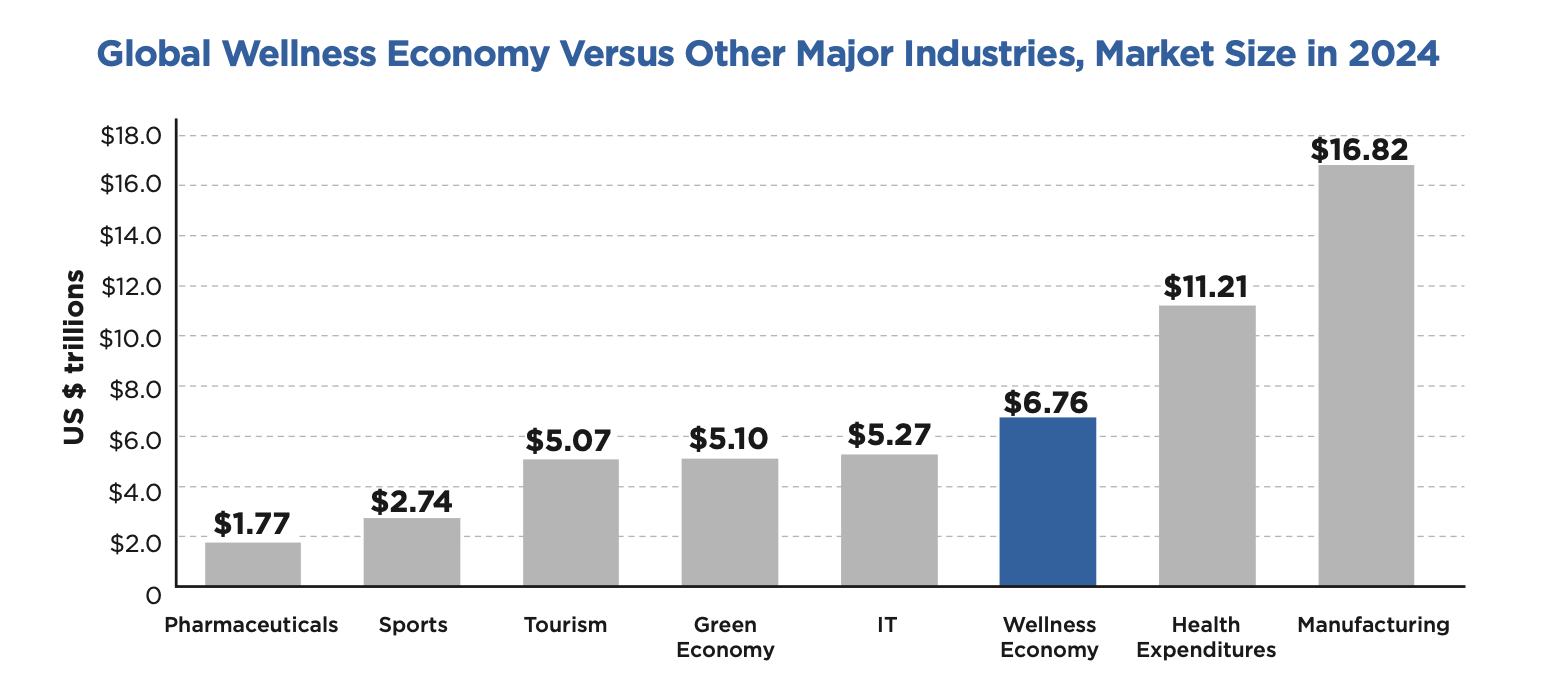
Wellness Real Estate is now a $548.4 billion sector. Growing at 19.5% annually.
The fastest-growing category in the entire $6.8 trillion wellness economy and the only sector that didn’t shrink during the pandemic.
People are spending less on apps.
They are spending more on where they are.
That shift is not aesthetic. It is not a luxury play. It is the market responding to decades of peer-reviewed science that most corporate wellness functions have never applied.
Today’s brief is about what that science says and why the companies that read it correctly are building the most defensible wellness advantage available.
1. The program isn’t the problem. The room is
Here is a scenario most wellness professionals know intimately.
The budget was approved. The app has been deployed. The mindfulness sessions are scheduled.
The people sitting under flickering 4000K overhead fluorescents, staring at a screen for 9 hours without a view of the outside world, are in a room that hasn’t had its air quality checked since the lease was signed.
Those people are not well because the environment was never addressed.
The environmental psychology field has understood this concept for over 30 years.
The corporate wellness industry has largely ignored it.
That is the gap this issue is about.
2. What the science actually says
On circadian lighting
The human body runs on a 24-hour internal clock, the circadian rhythm, regulated almost entirely by light.
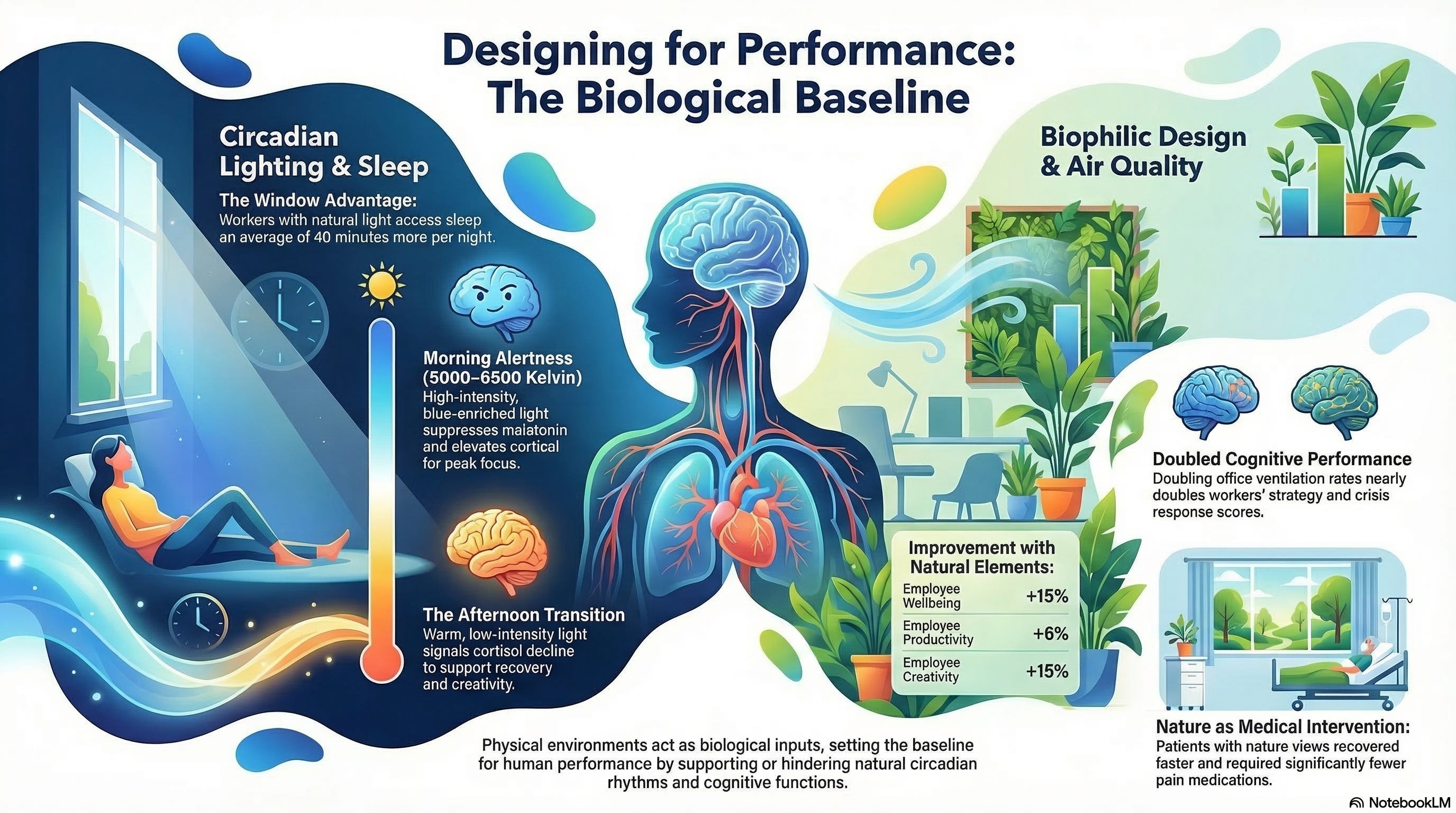
Blue-enriched, high-intensity light in the morning (5000–6500 Kelvin) suppresses melatonin and elevates cortisol, the neurological signal that the body should be alert, focused, and ready to perform.
Warm, low-intensity light in the afternoon signals the natural cortisol decline that supports recovery, creativity, and the parasympathetic state the body needs before sleep.
Most office environments deliver the opposite: flat, undifferentiated lighting at roughly the same temperature and intensity from 8am to 7pm.
The person arrives the next day already running behind.
A 2017 study published in Sleep Medicine found that workers in offices with windows slept on average 46 minutes more per night than those without access to natural light and reported significantly higher quality of life and physical activity levels.
On biophilic design
Biophilic design is the application of humans’ innate connection to natural environments. The research is extensive and consistent:
The Human Spaces study (Interface, 2015)—conducted across 16 countries with 7,600 respondents—found that employees in environments with natural elements reported 15% higher wellbeing, 6% higher productivity, and 15% higher creativity than those in spaces without them.
A Harvard T.H. Chan School of Public Health study found that doubling the ventilation rate in an office nearly doubled workers’ cognitive performance scores, specifically in areas of crisis response, information usage, and strategy.
Roger Ulrich’s landmark research indicated that hospital patients with a window view of nature recovered faster, required fewer pain medications, and had shorter stays than those facing a brick wall.
Circadian lighting, biophilic elements, air quality, acoustic design, and access to natural views are not decorative choices. They are inputs into human performance that operate before any program, app, or EAP is activated.
They change the baseline. The program then works on top of a better baseline.
When the environment is wrong, the best program in the world is fighting against biology. When the environment is right, even a modest program delivers outsize results.
3. Why the market is there (and who’s funding it)
The $548.4 billion Wellness Real Estate figure is not residential luxury. It is a category that includes office design, construction standards, and building certifications like WELL Building Standard and RESET Air, specifically engineered around the health of the people inside.
The WELL Building Standard now covers over 4 billion square feet across 100+ countries. It is not a fringe designation. It is a procurement specification that is beginning to show up in corporate real estate briefs across the GCC and globally.
What is funding this initiative? Two things converging simultaneously
First, the Over-Optimisation Backlash data we covered last month: 61% of employees feel pressure to appear well even when they’re not (Lululemon), and 45% report wellbeing burnout.
Second, the post-pandemic renegotiation of what office space is for. Companies spent 3 years trying to convince employees that offices were worth commuting to.
The organizations winning that argument built spaces that made people feel physiologically better just by being in them. The ones still losing the argument have an EAP and a free yoga class on Thursdays.
For 1 AED a day Wellness Intelligence subscribers, you get:
the 3 workplace design interventions you can do right away (and get paid for)
the exact budget conversation to use with decision makers
the language that translates wellness design into business terms
3 AI prompts to run your own workplace wellness design audit
All for less than 1 AED a day!
4. The three interventions
Not all environmental changes are equal. These three are ranked by strength of evidence and ease of implementation without a construction project.
Intervention #1—Circadian Lighting Audit & Retrofit Evidence strength: Very high | Speed to ROI: 6–12 weeks | Disruption: Low
It does not require architectural changes. It requires a lighting audit and a retrofit of existing fixtures or the addition of tunable LED systems.
What to measure before and after: sleep quality (self-report at 2 and 8 weeks), morning alertness ratings, afternoon energy dip frequency, and sick day frequency over a rolling quarter.
What to say in the brief: “We are proposing a circadian lighting protocol for [floor/team/building]. The science of circadian biology connects direct-spectrum lighting conditions to cognitive performance, sleep quality, and sustained alertness. We are measuring [X] as our baseline and projecting [Y] improvement over 12 weeks, with a cost of [Z] against a productivity value of [A].”
Intervention #2—Biophilic Integration and Materials Evidence strength: High | Speed to ROI: Immediate Disruption: Low to Moderate
The minimum effective dose here is higher than what most organizations implement. A single plant in the corner of a 40-person floor is not biophilic design, it is a gesture.
The Human Spaces research suggests that meaningful biophilic impact requires natural elements visible from most workstations, natural materials (wood, stone) in at least one primary interaction zone, and ideally a view of greenery or natural light from the majority of seated positions.
Where construction isn’t possible, green walls and planted partition screens are the most cost-effective route to meaningful biophilic coverage. They double as acoustic panels, addressing a second evidence-backed variable simultaneously.
What to measure: The Creative Experience subscale (part of the validated Work Design Questionnaire) is a proxy for the cognitive benefits of biophilic exposure.
What to say in the brief: “We are proposing a biophilic integration program for [space]. Research across 16 countries with 7,600 workers shows 15% higher wellbeing and 6% higher productivity associated with natural elements in workplace environments. Our proposal targets [specific outcomes] with [specific metrics] at a 90-day review point.”
Intervention #3 — Indoor Air Quality Monitoring
Evidence strength: Very high | Speed to ROI: Immediate
Disruption: Very low
The Harvard T.H. Chan finding that doubled ventilation nearly doubled cognitive scores is, in isolation, one of the most commercially significant studies in workplace wellness. It is almost never cited in corporate wellness conversations.
The first step is measurement. An air quality monitor (CO₂, VOC, PM2.5, humidity) costs between $100 and $1,500 depending on the specification. Most organizations have never measured the air quality in their buildings during high-occupancy periods.
Run a 5-day occupancy measurement across three environments (executive floor, open plan, and meeting rooms). Present the CO₂ readings at peak occupancy (anything above 1,000 ppm is associated with measurable cognitive impairment). That data is your business case.
What to say in the brief: “We conducted a 5-day indoor air quality audit. Peak CO₂ readings in [location] reached [X] ppm during [hours]. The Harvard research on cognitive performance and ventilation indicates that these levels significantly impair decision-making speed and accuracy. Upgrading ventilation on [floor] to bring CO₂ consistently below [Y] ppm has an estimated cost of [Z] against a modeled cognitive performance improvement of [A] across [N] employees.”
5. The budget conversation framework
Three steps. In this order.
Step 1—Establish the baseline with data, not opinion. Air quality readings. Lighting temperature measurements. Biophilic coverage percentage. These are facts from your building.
Step 2—Map the conditions to outcomes using published research. Each of the three interventions above has peer-reviewed outcome data. Use it. “According to a Harvard study published in Environmental Health Perspectives...” is a sentence that belongs in every corporate wellness proposal.
Step 3—Frame the investment as infrastructure, not a program. “We are proposing a physical infrastructure upgrade with measurable performance implications." Infrastructure language routes the conversation to the CFO’s frame of reference: capital expenditure, depreciation, asset value, and operational performance.
6. The AI prompts (use this week)
Prompt 1—Wellness Design Audit
“I am conducting a wellness environment audit of [type of office, size, number of floors]. Help me design a 5-day measurement protocol to assess: (1) circadian lighting conditions by time of day, (2) biophilic coverage percentage by workstation, and (3) indoor air quality levels during occupancy. Output as a structured checklist with measurement tools, timing, and what to record.”
Prompt 2—Business Case Builder
“I have the following data from a workplace environment audit: [paste your findings]. Using the following research references — Harvard T.H. Chan cognitive performance study, Human Spaces biophilic design research (Interface 2015), Sleep Medicine circadian lighting study (2017) — help me build a one-page business case for a facilities or CFO audience that frames three specific environmental interventions as cognitive performance infrastructure. Avoid wellness language. Use risk, performance, and asset language throughout.”
Prompt 3—Language Translation
“Translate the following wellness design concepts into boardroom-ready language for a CFO or COO audience. For each, give: the wellness term, the boardroom translation, and one sentence quantifying the business impact. Concepts: circadian lighting, biophilic design, indoor air quality management, acoustic design, access to natural light.”
Takeaway
The fastest-growing sector in the wellness economy is not growing because companies are suddenly interested in aesthetics.
It is growing because the evidence, 30 years of peer-reviewed environmental psychology, is finally reaching the people who control construction and real estate budgets.
The wellness professionals who understand these principles are not competing with HR benefit vendors. They are sitting in meetings with CFOs and real estate directors.
That is a different conversation. A better-paid one.
Hasta la vista, amigos!
Diego Carrete
Chief Wellness Officer, First Abu Dhabi Bank
Founder, Wellness Intelligence
Wellness Intelligence is a weekly briefing on the economics of wellness, corporate resilience, and the future of human performance. If you want to help someone in need of these weekly insights, gift them a subscription below.
SOURCES:
GWI 2025 Wellness Economy Monitor (Global Wellness Institute)
Human Spaces: The Global Impact of Biophilic Design in the Workplace (Interface, 2015)
Ulrich, R.S. — View Through a Window May Influence Recovery From Surgery (Science, 1984)
Allen, J.G. et al.—Associations of Cognitive Function Scores with Carbon Dioxide, Ventilation, and Volatile Organic Compound Exposures in Office Workers (Harvard T.H. Chan, Environmental Health Perspectives, 2016)
Boubekri, M. et al.—Impact of Windows and Daylight Exposure on Overall Health and Sleep Quality (Sleep Medicine, 2017)
WELL Building Standard—v2 current edition