


Hola amigos,
Como estais?
Before I start, if you are reading this newsletter, please don’t share it. This newsletter is a special edition for those of you who commented on my story. Normally it sits behind the paywall.
I write this piece from the back seat of my Patrol, waiting for my daughter to finish her gymnastics class.
And while I sit here, an AI is reading the wellness economy for me.
Three years ago that sentence would have been impossible.
Research meant a desk, a library of PDFs, a highlighter, and four hours I did not have.
One person is competing against consultancies that have research teams.
The math did not work.
It works now.
By the end of this brief, you will have:
The exact six-step research pipeline I run every week
One corporate wellness opening fully unpacked (and two more teased)
If you are busy, save this and come back to it with coffee. It is worth it.
1. One Person. A Research Team.
Here is the problem every solo wellness professional has.
The organizations funding the biggest corporate wellness contracts are the ones with market intelligence on their side of the table.
They know which sectors are growing.
They know which budgets are moving.
They know which language gets proposals approved and which gets them filed.
The wellness professional pitching to those organizations almost never has that intelligence.
They have their experience, their passion, and whatever they remembered from the last podcast they listened to.
The math used to favor the side with the team.
It does not anymore.
Not if you know how to build the pipeline I am about to show you.
2. The Six-Step Pipeline
Six steps.
Two tools.
Fifteen minutes, from start to finish.
Step 1—Open a credible source article
Pick a report that cites its sources heavily.
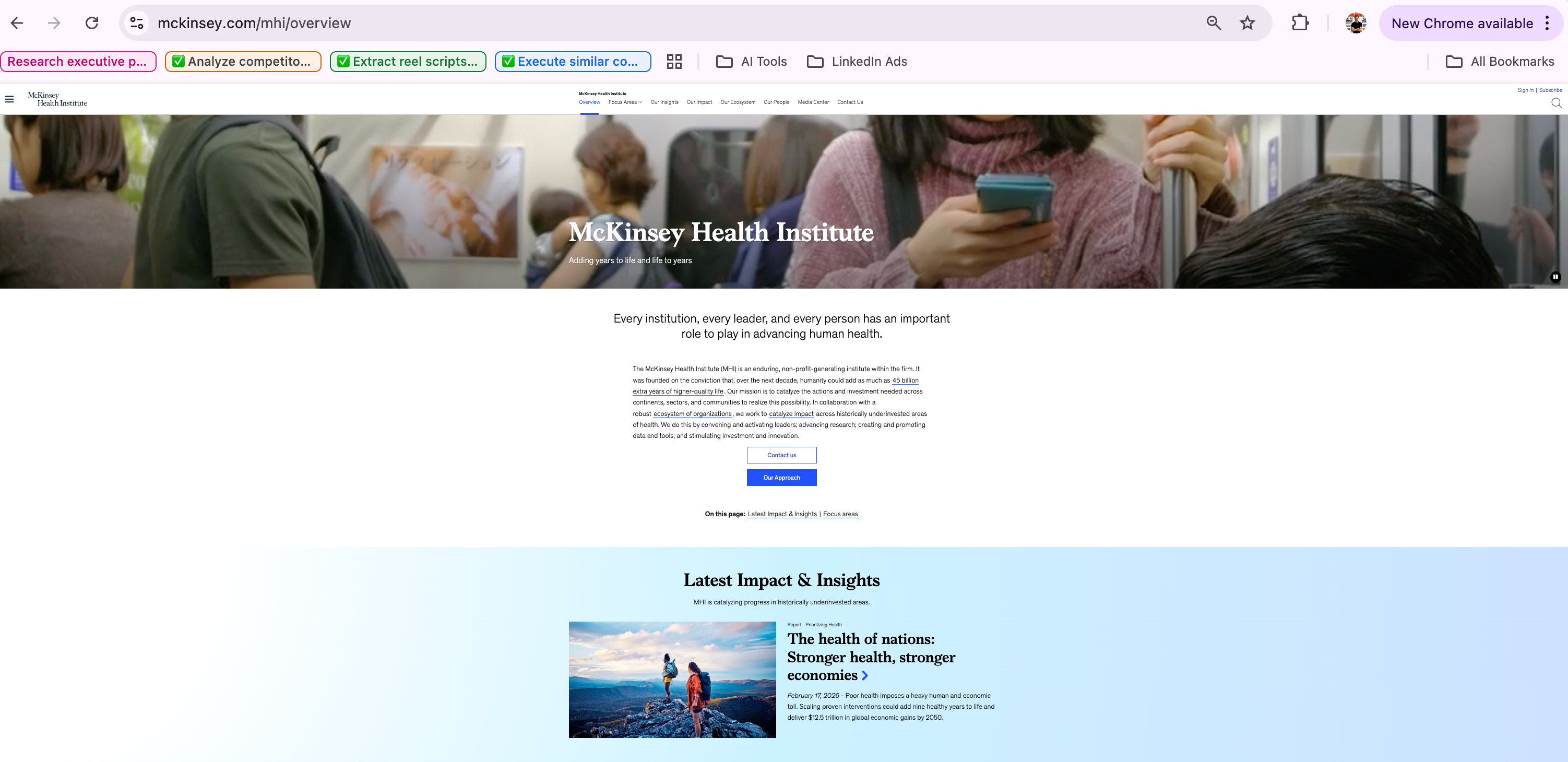
For this walkthrough I use the McKinsey Health Institute.
Their work on workforce wellbeing, brain capital, and healthy longevity is public, free, and footnoted end-to-end.
Every claim has a primary source behind it.
Open the McKinsey Health Institute overview page.
That is your starting point
Step 2—Install NotebookLM Tools
Go to notebooklm.google.com.
Free.
Sign in.
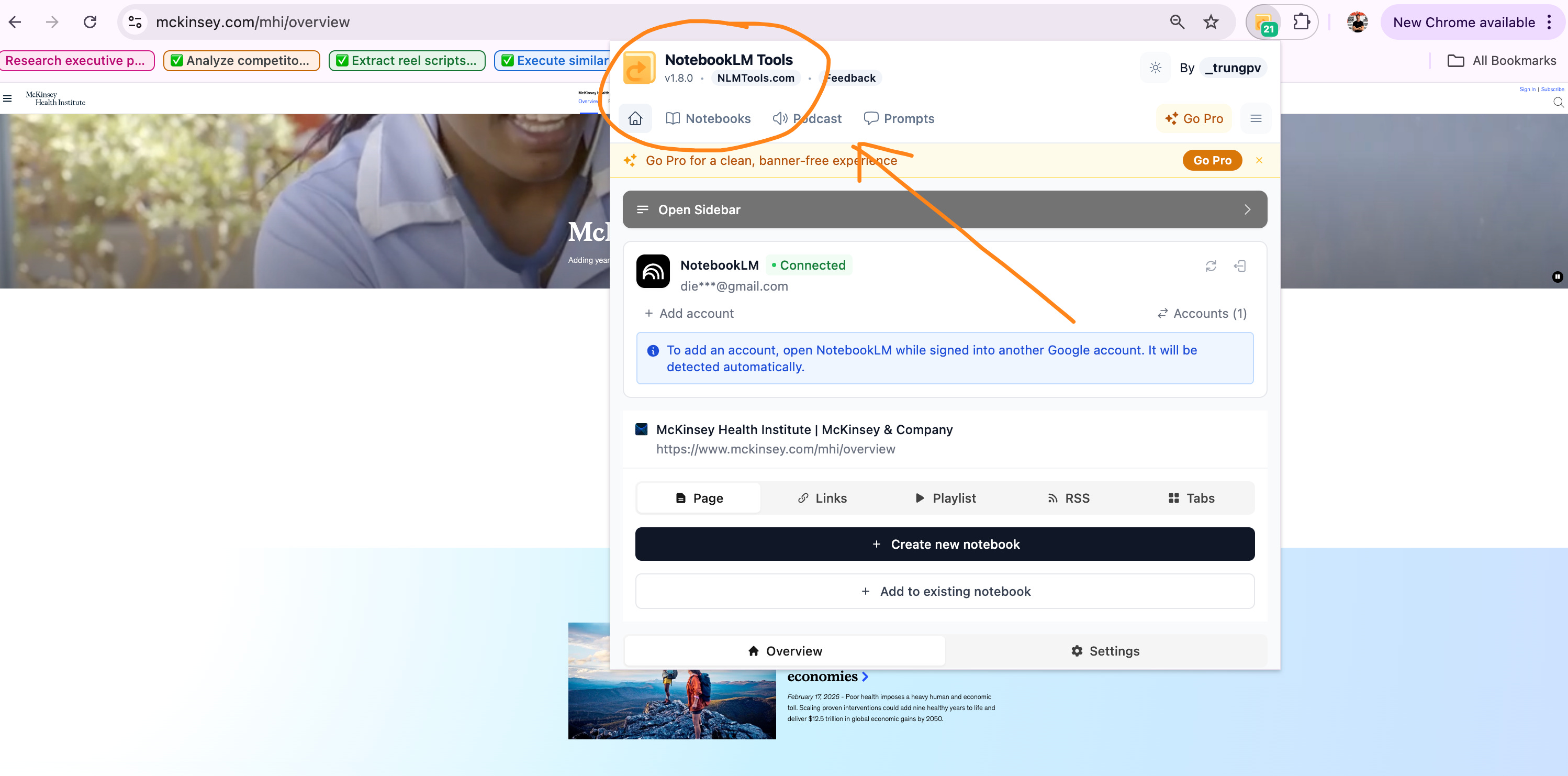
Then install the NotebookLM Tools browser extension from the Chrome Web Store (by _trungpv, via NLMTools.com).
One click.
You do this once.
Runs forever.
Step 3—Build the notebook from the article and its sources
Open the extension on the McKinsey page.
Switch from Page to Links mode.
Click “Extract links from page.”
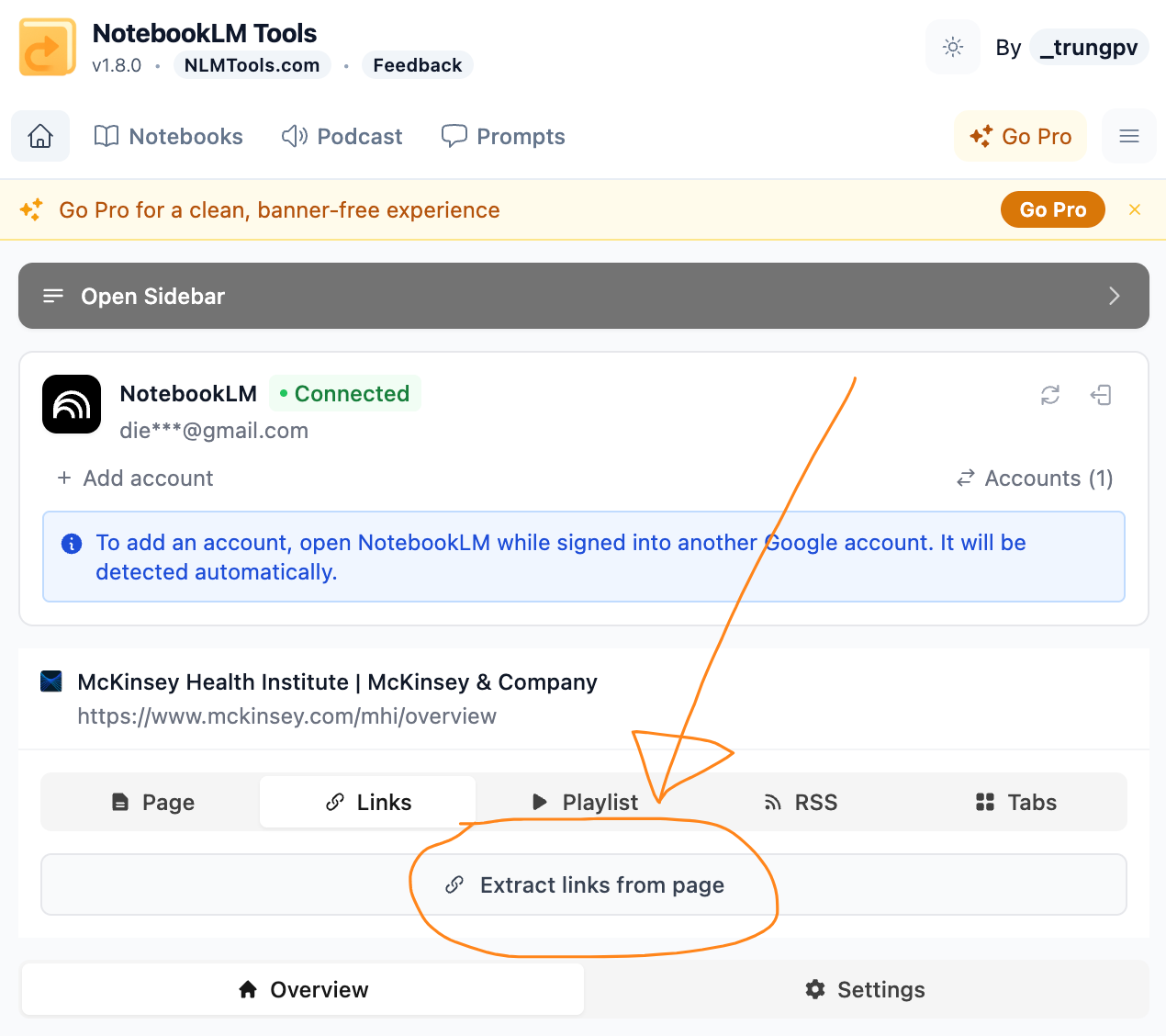
When I ran the test today, the extension pulled 38 linked sources in one click.
Every citation McKinsey makes across the page is captured.
Hit “Create new notebook.”
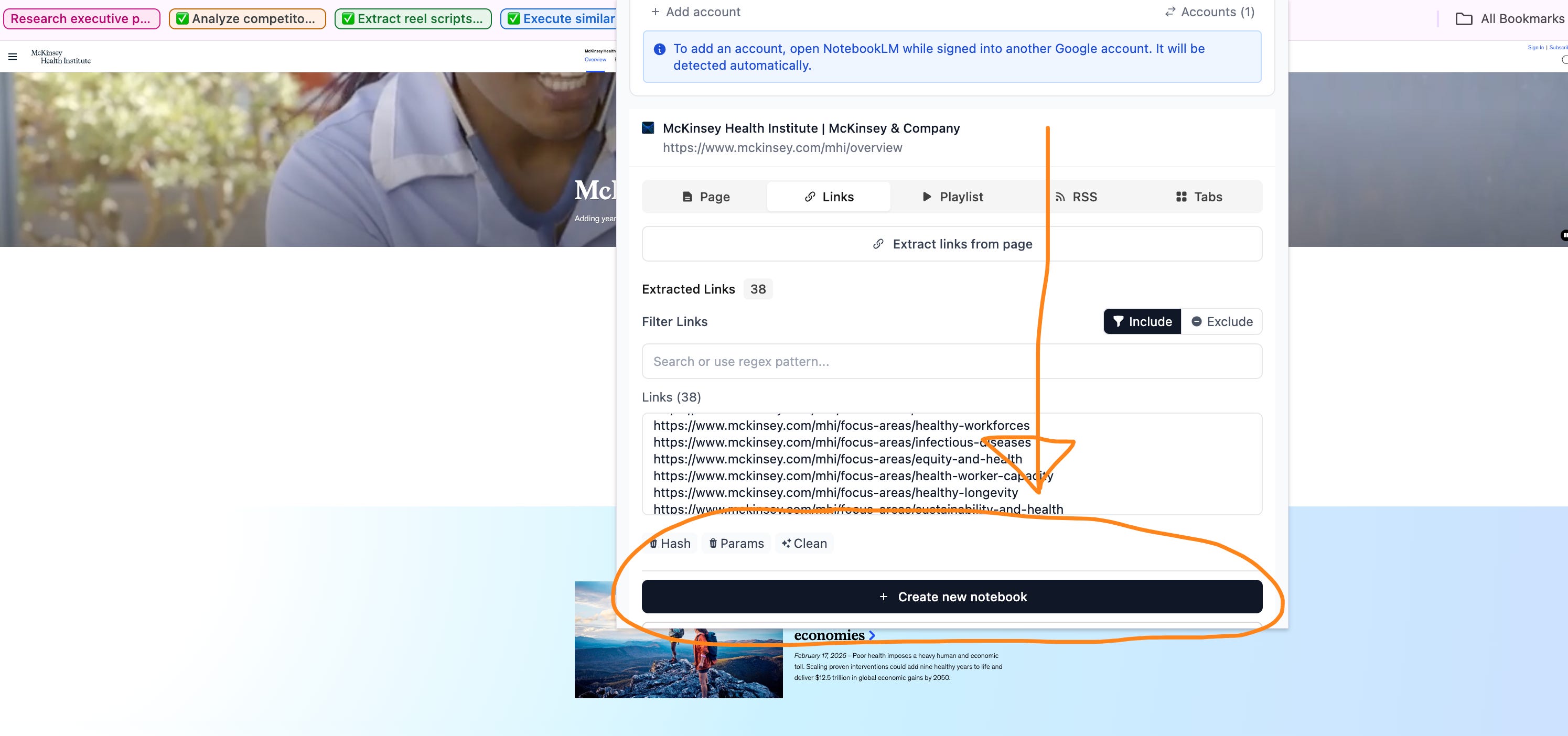
The notebook now holds 38 primary sources you did not sit down to assemble.
You did not read a single PDF.
Step 4—Ask NotebookLM for a grounded summary
Inside the notebook, type your question into the chat:
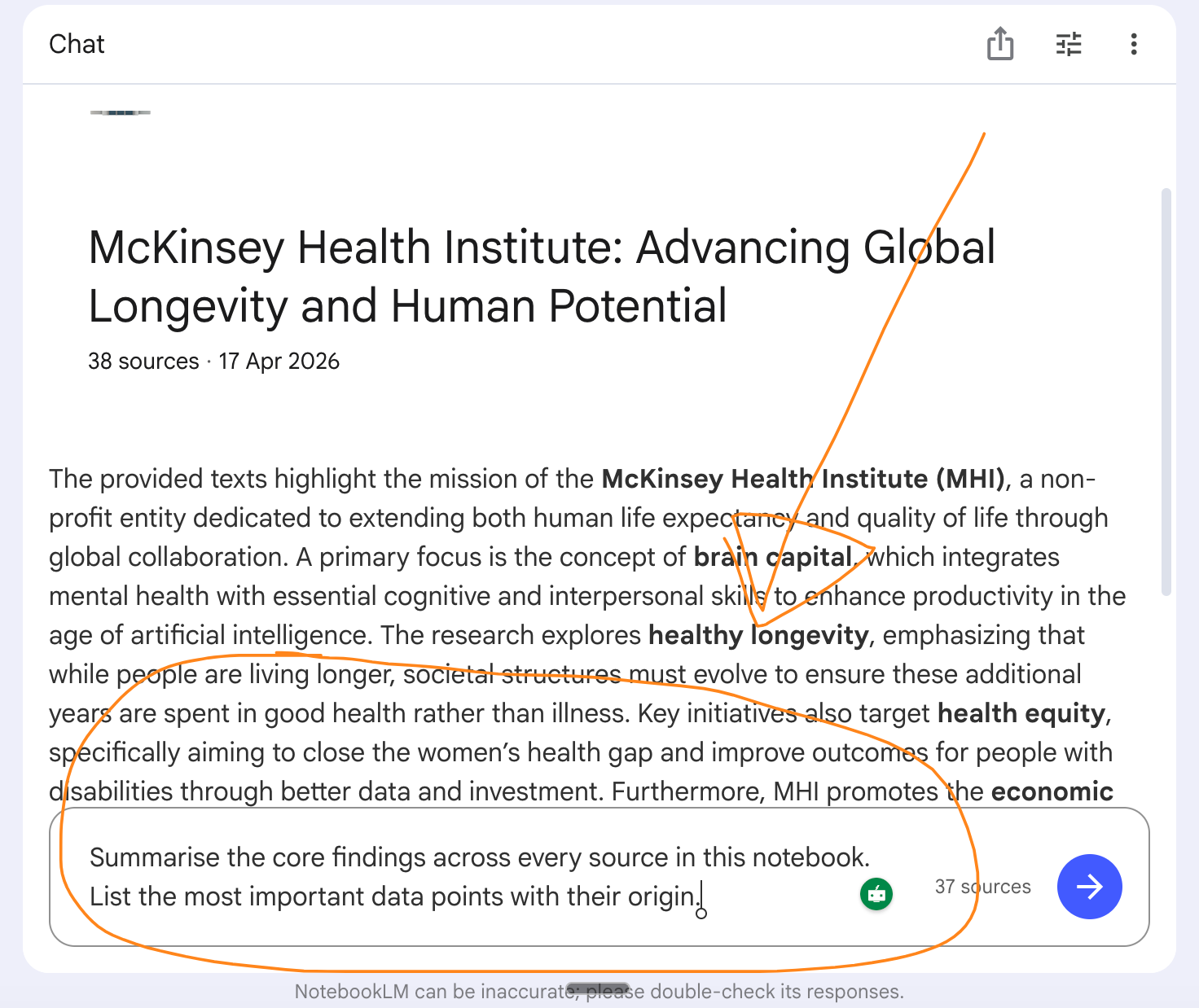
This is what used to be called a literature review.
It now takes ninety seconds.
Step 5—Export the summary as markdown
Once NotebookLM has produced the summary, click the export icon.
Select “Markdown.”
Download the file.
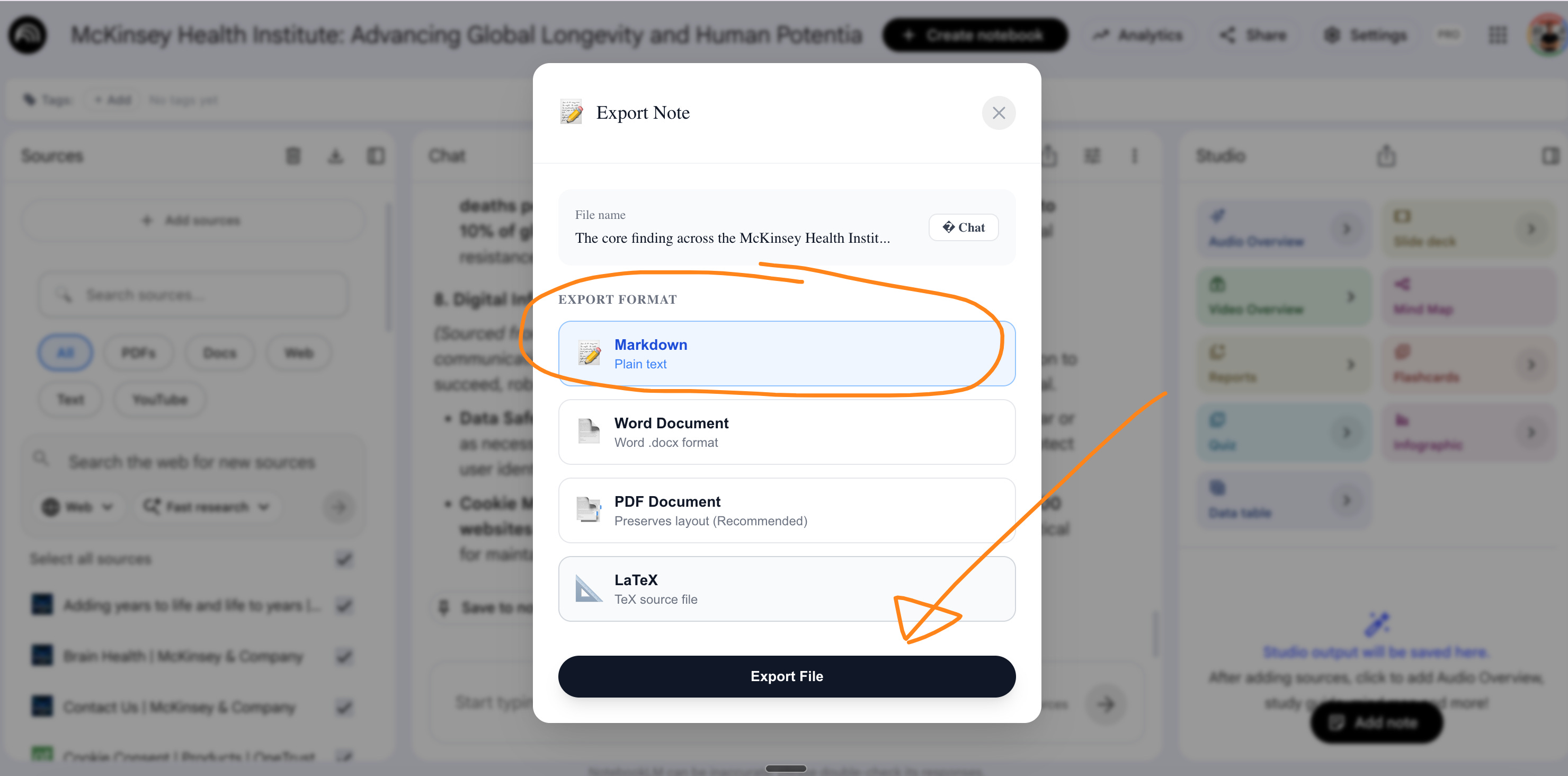
You now have a clean, structured synthesis of 38 primary sources in a format Claude can read instantly.
Step 6—Paste into Claude and ask the real question
NotebookLM is a reader.
It tells you what the sources say.
That is step one of intelligence.
Step two is pattern finding, which is what Claude is for.
Open a Claude chat.
Attach the markdown summary.
Then paste this prompt:
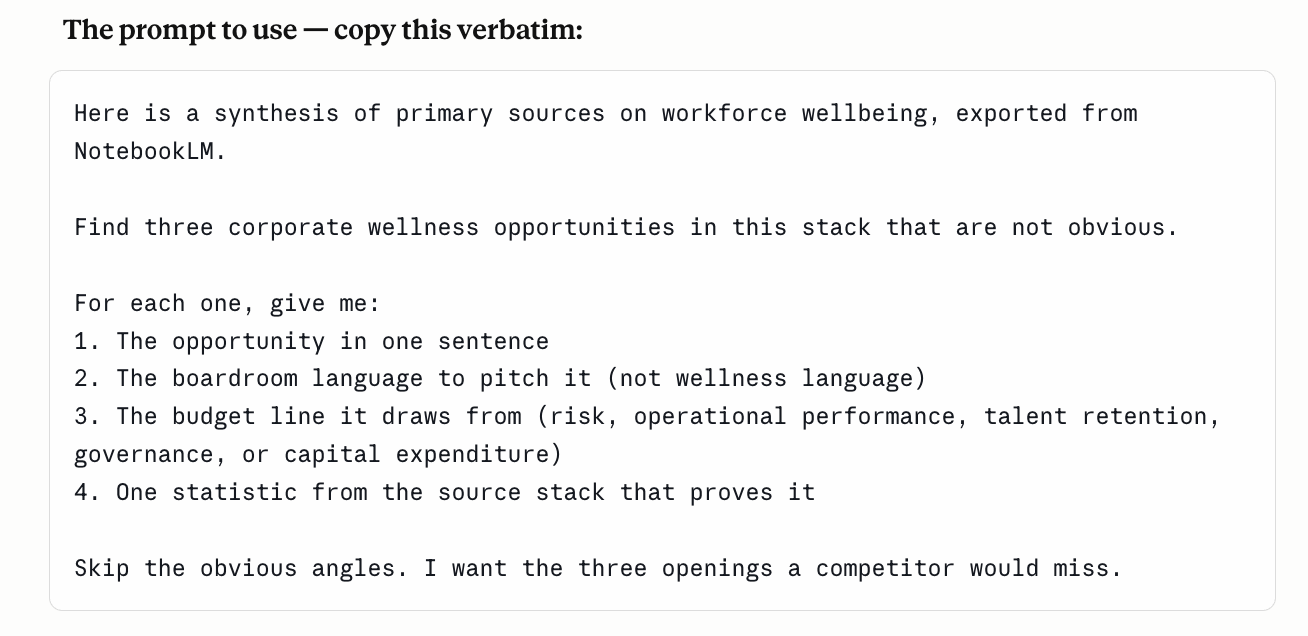
Claude returns three strategic angles.
Not summaries.
Opportunities are defined in the language that a corporate buyer funds.
Total time, start to finish: fifteen minutes.
One person.
From a cold article to three corporate-ready positions.
3. What the Pipeline Surfaced Today
I ran this pipeline on the McKinsey Health Institute stack before writing you this brief.
Claude returned three openings.
Every one of them sits in a budget line most wellness professionals never pitch to.
I am going to show you one in full.
I will unpack the other two in future issues.
Opportunity 1: Brain Capital as an AI-Transition Insurance Policy
The opportunity
Position cognitive health programs not as mental health benefits but as the underwriting mechanism for workforce AI-readiness—because the same cognitive capacities AI is exposing (judgment, attention, and adaptive thinking) are the ones brain health interventions protect.
The boardroom pitch
As we automate routine cognition, our residual workforce value concentrates in higher-order brain skills. We are currently underfunding the single asset class our AI strategy depends on. A brain capital program is a hedge against transition risk, not a wellness benefit.
The budget line
Risk — specifically, technology transition risk and workforce transformation reserves. Not HR. Not benefits.
The proof point
Brain health conditions account for 24% of the total global disease burden, yet only around 2% of global healthcare funding goes to mental health. That is a $200–350 billion annual funding gap sitting directly inside the capability the AI era rewards most.
Read the pitch again.
Nothing in it sounds like wellness.
It sounds like an actuarial note.
Which is exactly why it unlocks a budget that wellness never touches.
The other two openings are coming in future issues.
The same pipeline surfaced two more angles.
I will hold them for the next few weeks.
4. This Is What Wellness Intelligence Looks Like
What you just read is what Wellness Intelligence paid subscribers receive every week.
One run of the pipeline.
One set of opportunities.
One budget line most wellness professionals are not pitching to.
I unlocked this issue because the story that brought you here promised a working pipeline, and I wanted you to see the full thing, not a preview.
Less than 1 AED a day.
The question is not whether the subscription is worth the price.
You just read what it looks like.
The question is whether you want to jump in or remain on the sidelines.
Either way, I appreciate you!
Gracias, amigos.
I want to be honest about what this newsletter is and what it is not.
You might wonder why I do this.
Let me tell you why I don’t.
I don’t do this for the money.
My day job is Chief Wellness Officer.
That is the job that pays for my life.
Wellness Intelligence is something else.
Every penny that comes through this newsletter goes back into the masterminds I attend, the AI tools I build on, and the research access I use to stay ahead of the market.
The subscription funds the next issue.
Literally.
This publication is not a money-maker.
It is a purpose-giver.
That is why I can afford to give you a newsletter like this one and mean it.
Sources
McKinsey Health Institute—workforce well-being, brain capital, and healthy longevity research (public, mckinsey.com/mhi/overview)
NotebookLM (notebooklm.google.com, free)
NotebookLM Tools Chrome extension (NLMTools.com, by _trungpv, free)
Claude by Anthropic (claude.ai)