
Companies don't want wellness experts anymore
learn the language that gets budget approved

Wellness Intelligence – 26th February 2026
By Diego Carrete
THIS WEEK, INSIDE WELLNESS INTELLIGENCE:
The $6.8 trillion wellness economy is one that most cannot enter because they speak the wrong language in the wrong room.
A private conversation that exposed exactly where companies are breaking and why the last wellness initiative they tried created zero impact.
The Swiss principle that explains every failed corporate wellness program ever.
3 THINGS THAT YOU WON’T SEE IN THE NEWS THIS WEEK:
1. Social media is having its Big Tobacco moment. Austria, France, Denmark, Germany, Greece, Spain, and the UK are all moving toward banning social media for users under 16. Australia already did it.
2. In America, being wealthy doesn’t just mean a bigger house. The richest American men live 15 years longer than the poorest. The richest women live 10 years longer. Meanwhile, US households spend over $500 billion out of pocket on healthcare annually.
3. The Ozempic and Mounjaro rebound. 12% of Americans and 4% of British adults used weight-loss drugs in 2025. But people who stop taking it regain weight 4 TIMES FASTER than those coming off a traditional diet.
IF YOU ARE NEW TO WELLNESS INTELLIGENCE, START HERE:
Buenos días, amigos!
I was getting coffee at McDonald’s when I sat down to prep my day before heading to the office.
An older man was on his laptop, using two outlets. I asked politely if he could spare one so I could plug in.
We started talking, and that’s how I met the former CFO of one of Abu Dhabi’s largest companies: 67 years old, sharp, energetic, and carrying 35 years of leadership experience.
I don’t usually lead with my title. It can get in the way of natural, human conversation. But once he opened up, I shared it.
He smiled and said, "Wow. That’s the way of the future.”
Every company will have a Chief Wellness Officer by 2030.
Earlier this week, 110 of you shared candid input about your careers and your willingness to pivot into wellness full-time, or at least make it financially viable.
I get it. Trying to build this alone can drain your mental health.
I’ve been there. More than once.
Most of you said the same thing in different words:
You’re afraid big companies will see you as a “hobbyist” and not a professional.
Today, I’m going to help you close the Credibility Gap.
WHY COMPANIES DON’T CARE ABOUT YOU OR ME
Wellness is now a $6.8T global economy.
When you stop positioning yourself as someone who “does health” and start positioning yourself inside an economic and operational shift, you move from coach to strategic partner.
Companies don’t care about your accolades.
They care about what you can do for them.
And the right language is what moves you from one-off pilot initiatives to long-term partnerships that pay what you’re worth.
Most deals aren’t lost because the work is weak.
Deals are lost because the positioning is weak.
Most fitness professionals come across like outsiders in the boardroom, trying to earn credibility by performing expertise. The budget holder subconsciously files you under:
Nice-to-have
HR perk
Cuttable
You don’t want to sound clever.
You want to sound like them.
You’re translating your value into the operating system of the organization: risk, continuity, safety, and readiness.
WHAT COMPANIES WANT IN 2026
Last week at the Open Masters, I spoke with a GCHRO and the Head of Benefits at one of the UAE’s largest companies.
They asked for my advice on how to embed wellness into operations so they could stop bleeding money and trust. I asked one question:
“Where is the organization currently breaking?”
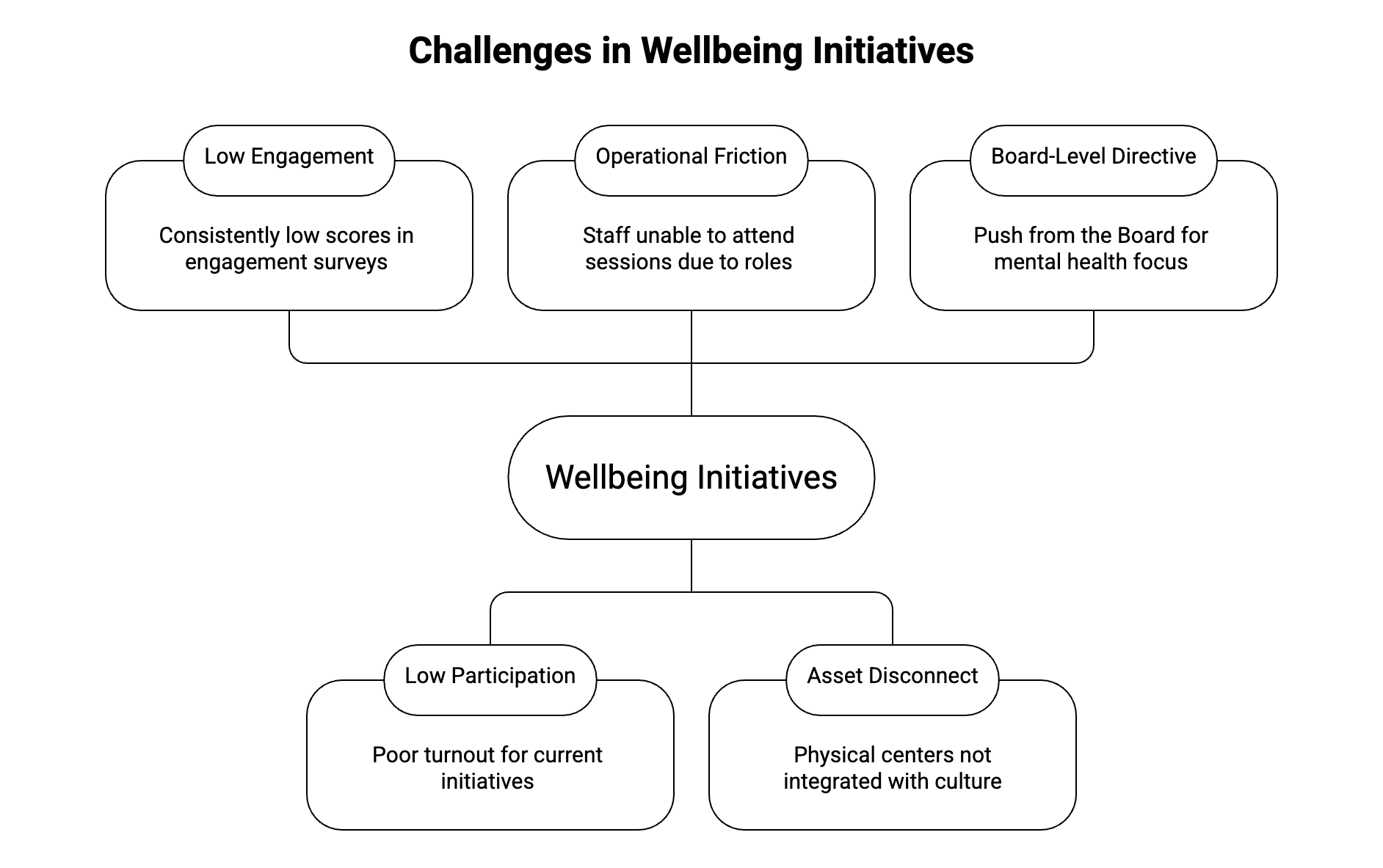
They gave me five pain points that will feel uncomfortably familiar if you’ve ever tried to sell in this space:
Low engagement: Wellbeing scores are consistently low in engagement surveys.
Low participation: Turnout for current initiatives is low.
Operational friction: Many staff can’t attend sessions because of how their roles run.
Asset disconnect: They have medical centers, but they’re not integrated into the culture.
Board directive: The Board is pushing a focus on mental health and psychological safety, turning a strong safety mindset into a real wellbeing agenda.
Then came the line that mattered most:
They’re not interested in another checklist program.
They want something that fits how the business actually runs.
And they admitted what failed before:
They tried to roll out wellbeing through an EVP “benefits” lens.
It burned time, energy, and resources.
Here’s why, and this visual says it better than I can.
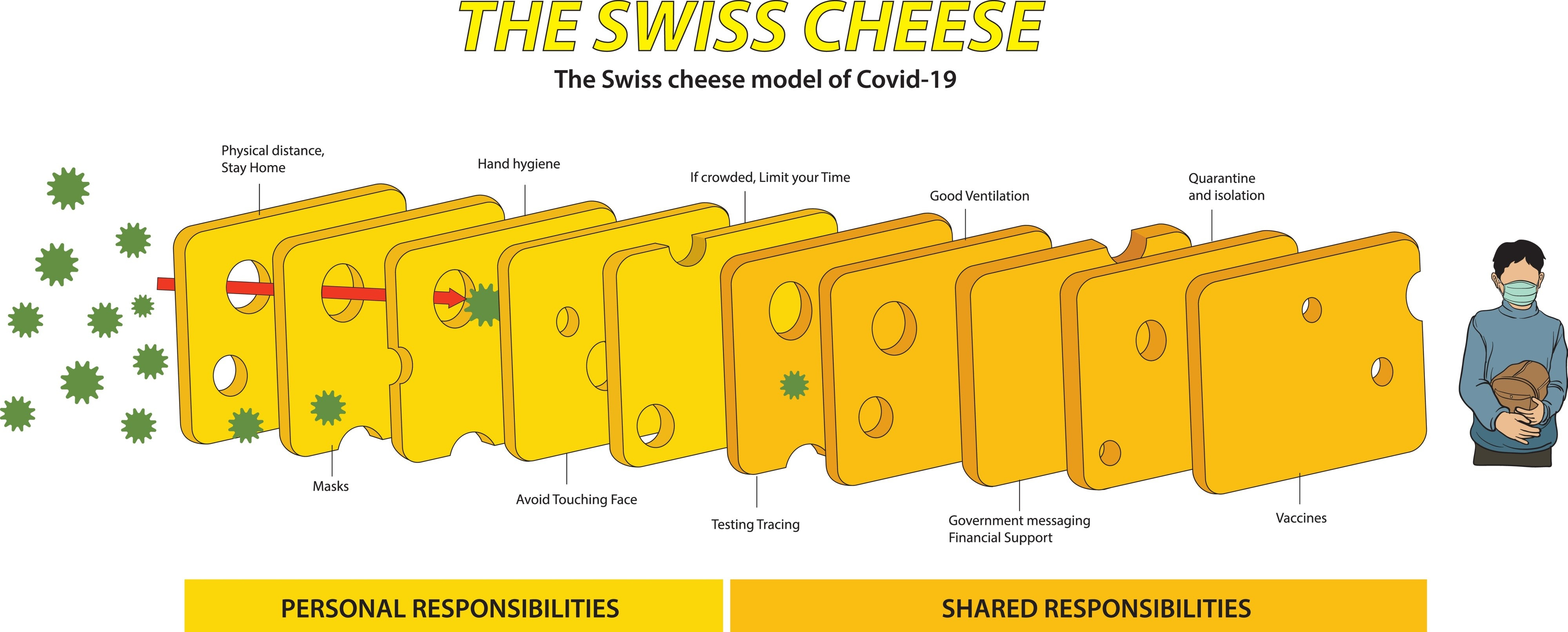
This is the Swiss Cheese Model, developed by safety researcher James Reason and widely used in risk management (and made popular during Covid).
The idea is simple: no single layer of protection is perfect. Every layer has gaps. But when you stack multiple layers, the gaps stop lining up—and risk drops dramatically.
The same logic applies to organizational wellbeing.
When a company runs one programme, launches one initiative, or buries wellness inside a benefits package, it’s relying on a single layer to do the job. The gaps stay open. Problems pass straight through.
What works is a system: leadership resilience, psychological safety, operational design, cultural integration, and frontline access. Each layer is imperfect on its own. Together, they hold.
That company had one layer. That’s why it failed.
WHAT COMPANIES ARE ACTUALLY BUYING
Companies don’t buy “wellness.”
“Wellness” is vague. Soft. Hard to defend in a board meeting.
Companies buy:
Stability
Safety
Operational readiness
They want to know their leaders and frontline staff will hold steady when pressure rises, sleep drops, and decisions get expensive.
And they want something else, whether they say it openly or not:
Proof.
Verifiable indicators that your work reduces business risk, not just improves mood.
Because if impact can’t be measured, it can’t be funded.
DON’T BE AN EXPERT
Most health professionals behave like experts.
Experts sell process:
workouts, meal plans, tracking, and stress hacks.
Architects sell assets:
the humans who keep the organization running.
That difference sounds small. It isn’t.
When a key leader breaks, burnout, cognitive decline, a sudden health event, the organisation doesn’t just lose a person.
It loses judgment.
It loses momentum.
It loses continuity.
And often, it loses millions through slow decisions, avoidable errors, and leadership disruption.
That’s why “expert” positioning caps your value:
Experts sell inputs.
Architects protect outcomes.
WHY COMPANIES ARE LISTENING IN 2026
Business isn’t stable anymore.
Markets move fast. Regulations shift. Talent churns. Reputation risk travels at the speed of a screenshot.
Boards aren’t looking for feel-good initiatives.
They’re looking for anchors.
“Stress management” is reactive language; it implies the system is already failing.
Boards respond to proactive language:
Resilience infrastructure.
Because a regulated nervous system makes calmer decisions under pressure.
And calmer decisions reduce errors, incidents, and costly judgment lapses.
In high-stakes industries, safety is a pricing model.
One serious mistake can cost more than your entire annual fee.
That’s how risk works.
HOW TO BECOME “FUNDABLE”
This is where most people get it wrong.
They think they need to sound more sophisticated.
They don’t.
They need to sound familiar to the people holding the budget.
So you stop using amateur labels and start using operational language, not to impress, but to be understood instantly.
A few examples:
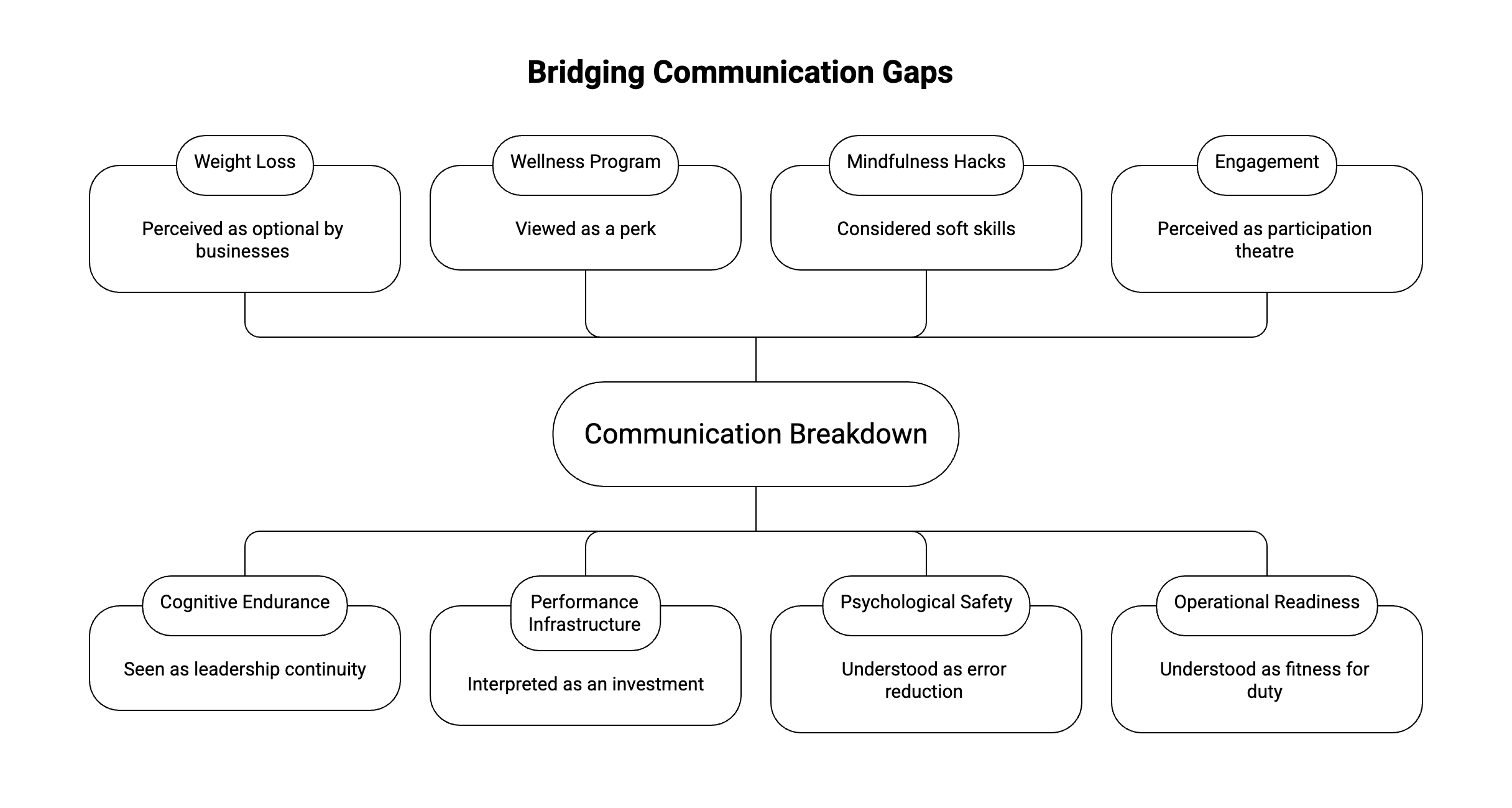
When you say, “I help people lose weight,” the business hears optional.
When you say, “I protect decision quality under pressure,” the business hears leadership continuity.
When you say “wellness program,” the business hears perk.
When you say “performance infrastructure,” the business hears investment.
When you say “mindfulness and stress hacks,” the business hears soft.
When you say “psychological safety under pressure,” the business hears fewer errors and safer outcomes.
When you say “engagement,” the business hears participation theater.
When you say “operational readiness,” the business hears fit for duty—desk and frontline.
That last point matters more than most people realize:
If your solution only reaches desk workers, you haven’t built a company-wide system.
You’ve built an administrative task that performs well on slides and fails in reality.
If you want board-level trust, adopt strategic restraint.
Don’t drown them in physiology.
Don’t use jargon they can’t audit.
If it can’t sit next to a risk statement, it doesn’t belong in the pitch.
Don’t ask, “Does that make sense?”
Lead like a business partner:
“My recommendation for our next step is…”
And don’t sell activities.
Sell outcomes, constraints, and risk reduction.
In corporate terms, you are not a coach conducting sessions.
You’re protecting the organization’s most expensive infrastructure:
It’s people.
THE LINE TO REMEMBER
You don’t want to sound clever.
You want to sound like them.
Hasta la vista, amigos!
Diego Carrete
Chief Wellness Officer
My book, The Evergreen Company, hits shelves before summer. It’s everything I know about building organizations that grow without burning people out. The kind of book that should be on every executive’s desk.
If you gift a yearly subscription to someone who belongs in this conversation, I’ll send you a free copy one month before it’s available in stores.
Gift a yearly subscription, then reply to this email with your confirmation and I’ll take care of the rest.
BONUSES
I have upgraded my private studio, which contains the same intelligence I use daily. Ask the model, and you will get my brain in a nutshell.
The World’s Most Important Problem by Gallup
I’m here for your pivot on language — especially when discussing topics like health and wellness which don’t get their due because they “feel vague and arbitrary” 🤮. Value must be translated in decipherable terms and don’t forget the humans!