
A $9.8 trillion wellness market. Mostly untapped
5 high-paying health & wellness roles emerging this year

Hola amigos,
The wellness economy is not short on professionals.
It is short on translation.
While the market reached $6.8 trillion in 2024 and is projected to approach $9.8 trillion by 2029, most operators are still competing in familiar lanes: generic coaching, one-to-one services, and broad wellness offers that are hard to differentiate.
Meanwhile, the fastest growth is happening in areas like wellness real estate and mental wellness, where demand is becoming more specific, more integrated, and more commercially meaningful.
That is the real talent gap.
Not a lack of passion.
Not a lack of certifications.
A lack of people who can take emerging health problems, connect them to real-world business needs, and build offers around them.
This is where the next wave of wellness work is heading.
My framework below captures five emerging role directions:
CNS Coach
Sleep Analyst
GLP-1 Coach
Head of Wellness
Circadian Coach
On the surface, they look like niche titles.
In practice, they point to something much bigger: wellness is moving away from generic encouragement and toward specialized problem-solving.
Let’s dive in right away.
Why this shift matters
The market itself is changing shape.
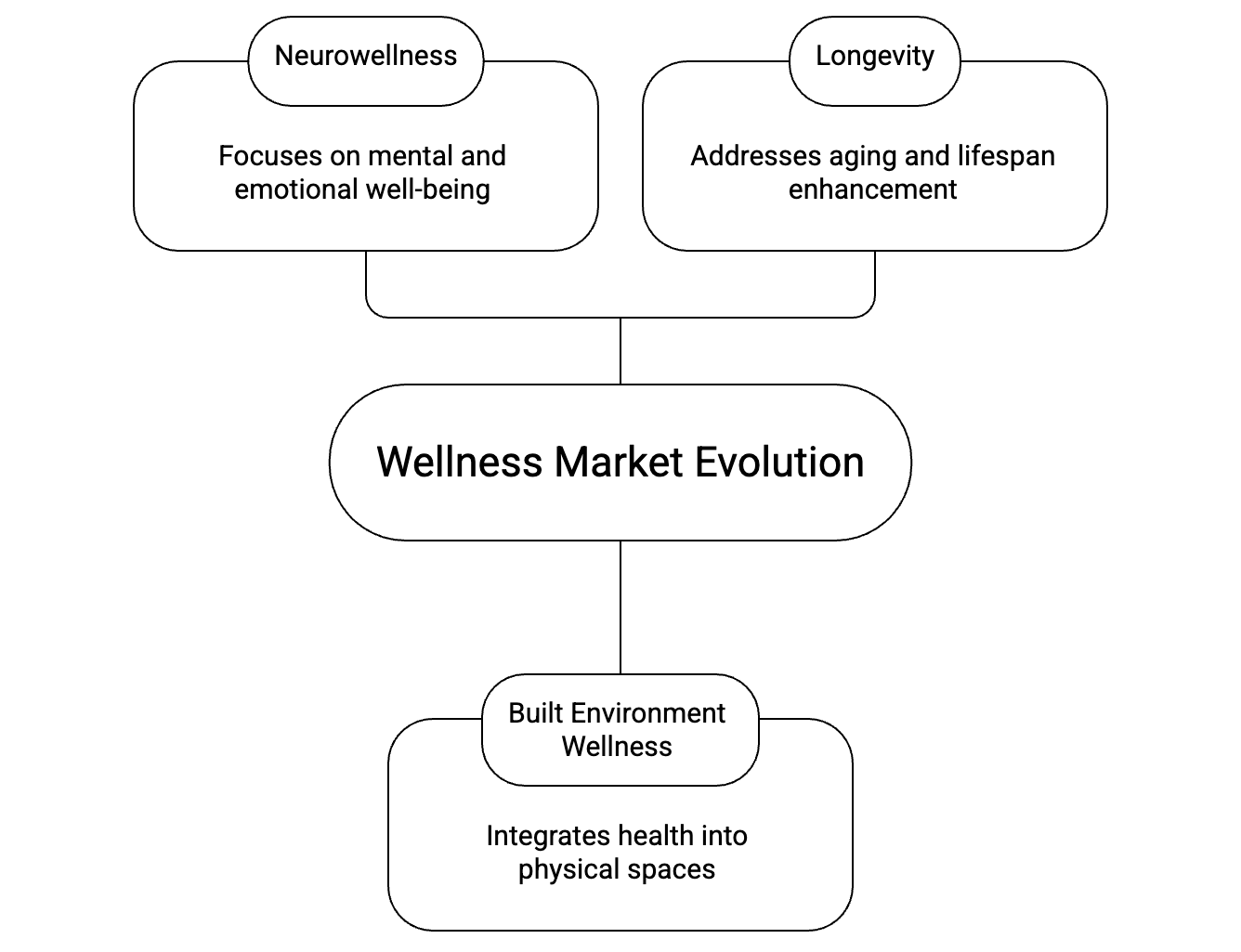
1) Neurowellness is becoming a major frontier
Modern life keeps people in chronic overload.
The category is no longer just about “stress management.” It is increasingly about:
regulation
recovery
resilience
cognitive clarity
sleep
sustainable performance
The commercial opportunity is especially strong in low-friction solutions that help people regulate quickly and consistently.
2) Wellness is moving into the built environment
Wellness real estate is already a $548.4 billion sector.
Healthy building practices are spreading into:
offices
hospitality
mixed-use developments
corporate workplaces
That matters because some of the next wellness roles will not be sold as “coaching” at all.
They will be sold as:
design
operations
performance protection
risk reduction
3) Longevity is becoming more specific
The 2026 trends report makes a strong point:
The market is correcting away from generic, male-centered longevity and toward more specific biology, more human approaches, and interventions designed for real life stages.
In plain terms, the opportunity is no longer to simply say you do longevity.
The opportunity is to solve the neglected, expensive, measurable problems sitting underneath it.
The big takeaway
What ties all of this together is simple:
New problems create new professions.
And the operators who win will be the ones who stop selling wellness as inspiration and start delivering it as infrastructure.
For free subscribers: what this means
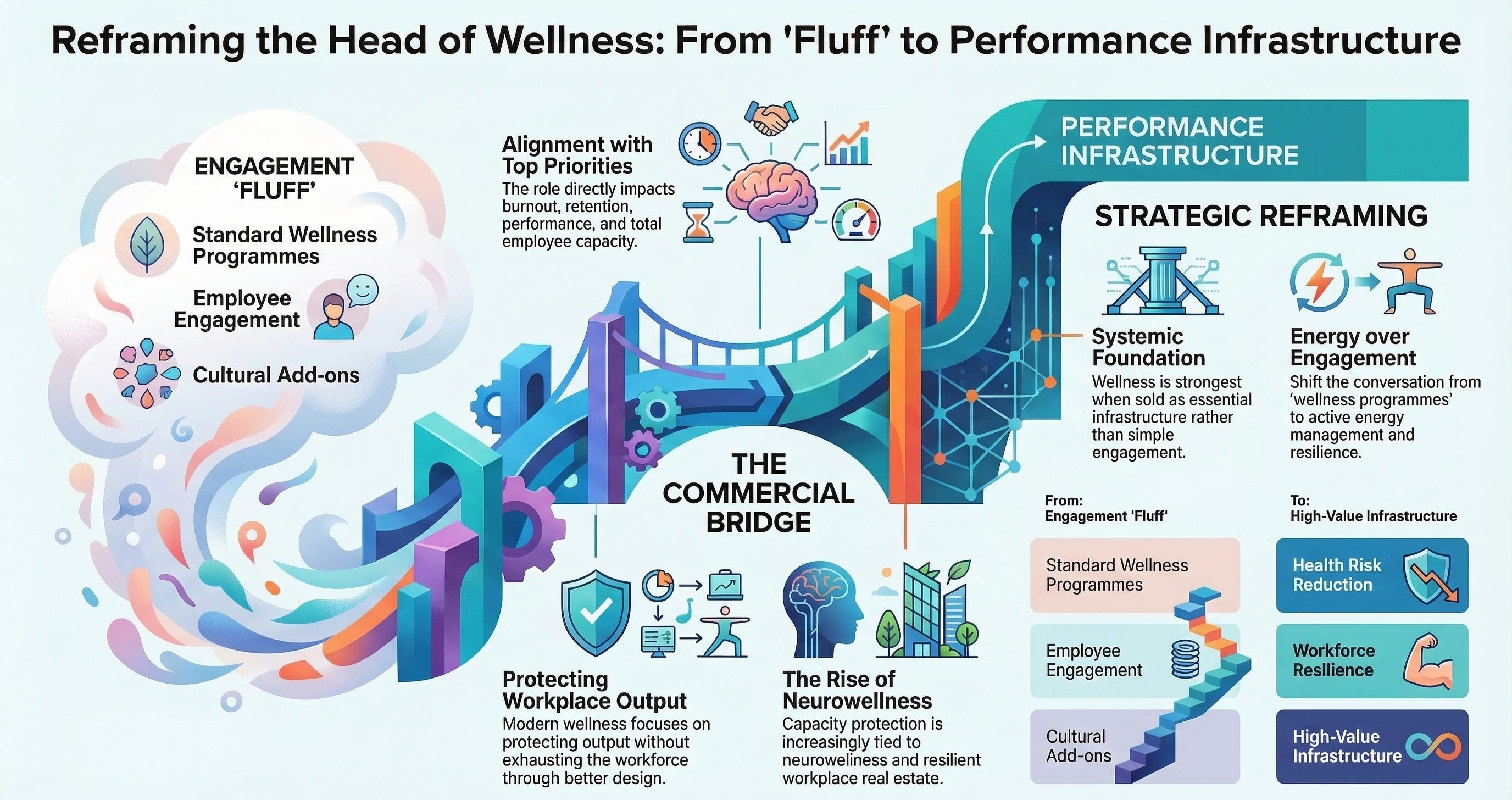
First, broad wellness positioning is getting weaker
The market is maturing.
Buyers do not just want someone to “help people get healthier.”
They want someone who can solve a specific:
performance problem
recovery problem
prevention problem
environment problem
And they want that solution described in language that feels relevant to the world they operate in.
Second, the biggest opportunities sit at the intersection of wellness and adjacent budgets
Think:
corporate performance
healthy workplaces
real estate
women’s healthspan
prevention
recovery
nervous-system regulation
The closer your work sits to an existing business priority, the easier it is to justify commercially.
Third, the next premium offers will not look like generic coaching packages
They will look like specialized systems:
assessment
interpretation
protocol
environment
reporting
Paid subscribers can read on for:
which of these five roles are closest to budget right now
how I would package each one commercially
the positioning shift that turns “wellness coaching” into a higher-value offer
how I’d place my time over the next 12 months to capitalize on this
The deeper opportunity starts here
The free version gives you the map. The paid version gives you the deeper breakdown, the practical packaging logic, and access to the custom GPT I built to help you sharpen your offer. On the annual plan, premium now comes in at less than AED 1 per day.
Here is the part most wellness professionals miss
Not every emerging role is equally monetizable at the same time.
Some are closer to an existing budget.
Some are closer to a consumer pain point.
Some are intellectually interesting, but still too early to build a business around unless you already have distribution.
That distinction matters.
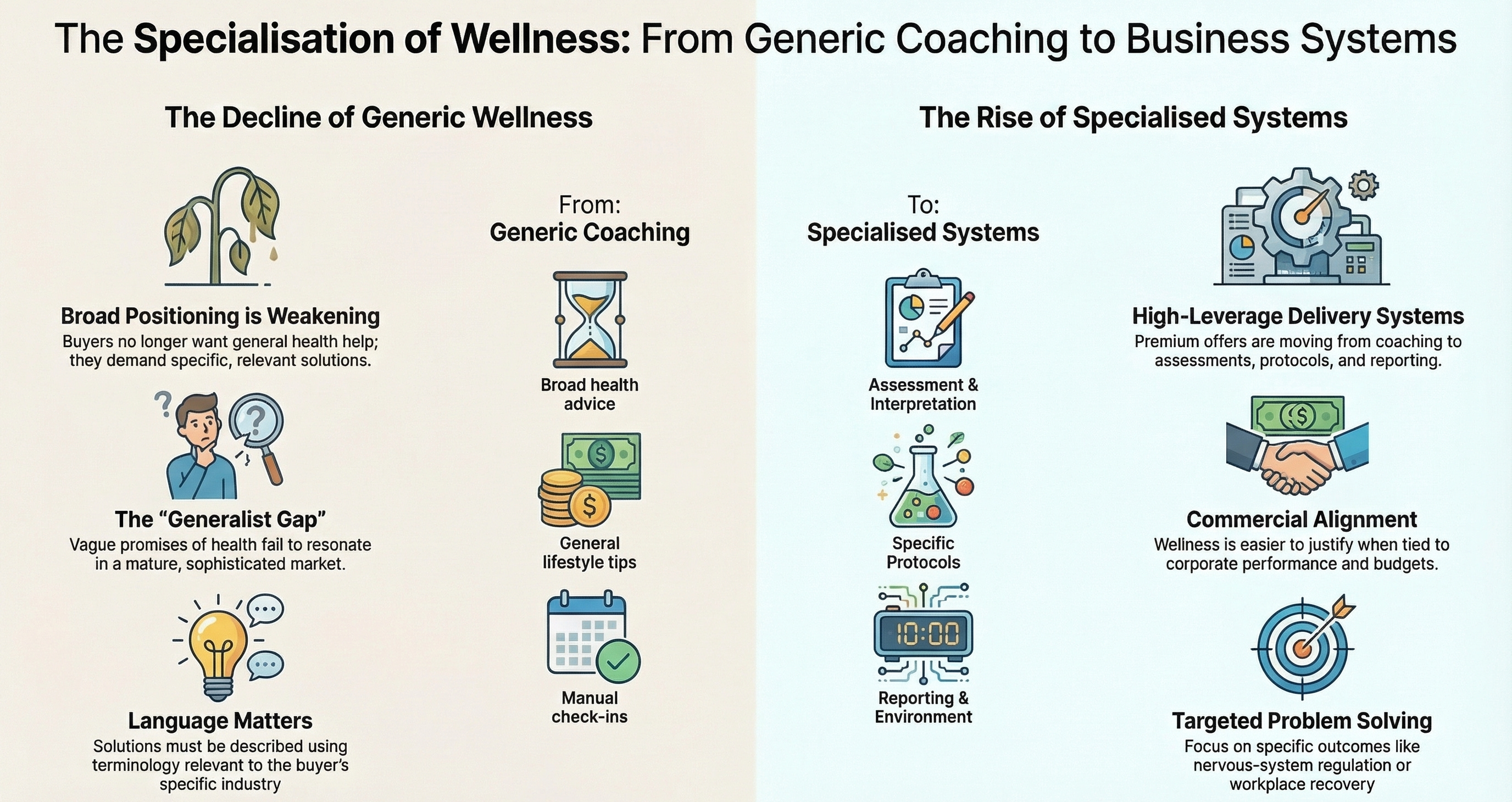
1) Closest to budget now: Head of Wellness
If I had to pick the role with the clearest commercial bridge, it would be this one.
Why?
Because it sits closest to existing company priorities:
burnout
retention
performance
employee capacity
workplace design
protecting output without grinding people down
Workplace wellness itself remains a smaller and slower-growing sector than others, but healthy workplace design and wellness real estate are becoming more relevant to employers.
Neurowellness is also increasingly tied to corporate wellness through capacity protection.
This role works best when it is not framed as culture fluff.
It should be framed as:
energy management
health risk reduction
workforce resilience
performance sustainability
better use of existing benefits, data, and environments
That is a very different conversation from:
“Let’s do a wellness program.”
Takeaway: Head of Wellness is strongest when sold as performance infrastructure, not employee engagement fluff.
2) Strongest adjacent opportunity: Sleep Analyst and Circadian Coach
These two are more commercially powerful than most people realize.
Sleep is no longer just personal health content.
It now sits inside:
mental wellness
performance
nervous-system regulation
hospitality
executive recovery
building design
Meanwhile, wellness real estate and healthy buildings are moving from niche to mainstream, including in offices and larger development portfolios.
If you are building here, do not position yourself as “the sleep person.”
Position yourself as the person who can:
translate sleep and recovery data into decisions
redesign routines and environments around recovery
reduce cognitive drag in high-demand populations
improve readiness, not just rest
Circadian work gets even stronger when bundled with space.
Lighting, air, sensory load, walkability, recovery rooms, and default movement design all push this beyond wellness content into operational value.
That is a much more serious offer.
Takeaway: Sleep and circadian work become premium when they move from education into readiness, environment, and decision-making.
3) Biggest strategic wave: CNS Coach
I would probably rename this in market-facing language, but the direction is right.
Neurowellness is one of the clearest signals in the 2026 report.
It bridges:
mental wellbeing
performance
longevity
And it creates opportunity across:
consumer tech
hospitality
real estate
preventative care
corporate wellness
The report is explicit on one key point:
The biggest opportunity lies in solutions that reduce friction and help people regulate in minutes, not hours.
That means the commercial winner is probably not the operator who makes this sound deep or spiritual.
It is the operator who makes it usable.
In practice, that looks like:
better meeting-day protocols
decompression systems for executives
recovery sequences for shift workers
nervous-system-friendly gym, office, or hospitality experiences
simple, repeatable regulation tools with clear use cases
The market does not need more vague stress talk.
It needs better regulation infrastructure.
Takeaway: CNS work wins when it is practical, fast, repeatable, and embedded into real environments.
4) High-pain, high-demand, but package carefully: GLP-1 Coach
This is real.
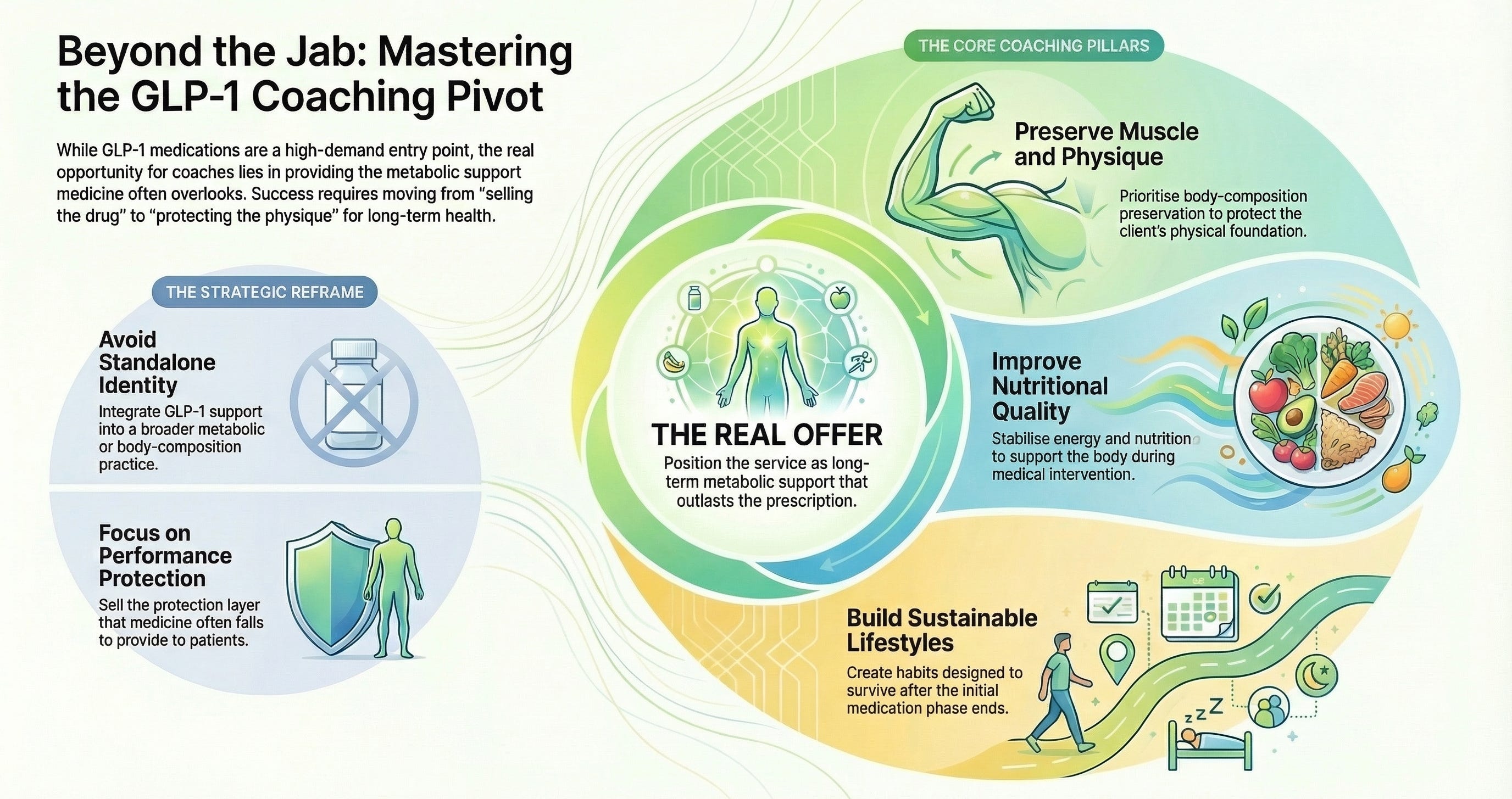
But I would not build it as a forever standalone identity unless you already dominate that lane.
I would build it as a metabolic-support or body-composition-preservation offer inside a broader practice.
Why?
Because the true problem is bigger than the drug.
The real opportunity is helping people:
preserve muscle
improve nutrition quality
stabilize energy
create a lifestyle that survives after the initial intervention
In other words, do not sell “GLP-1 coaching.”
Sell the performance and physique protection layer that medicine often does not provide.
The role itself comes from your framework.
The stronger business move is how you package it.
Takeaway: GLP-1 is a strong entry point, but the real offer is long-term metabolic support that outlasts the prescription.
5) Underpriced long-term opportunity: women-specific longevity
This is not one of the five titles in your framework, but it is one of the clearest gaps in the reports.
The 2026 trends report argues that longevity is pivoting toward women’s healthspan, with:
more targeted diagnostics
more relevant interventions across life stages
a broader move away from hyper-optimization
more human, integrative models
That creates room for entirely new offers, especially for operators who can combine:
strength
recovery
biomarkers
lifestyle
life-stage intelligence
This matters because markets do not just grow by getting bigger.
They grow by getting more specific.
And specificity is where premium positioning lives.
Takeaway: Women-specific healthspan is underpriced because the market is only beginning to catch up to its real complexity and demand.
How I would package these roles
The mistake is to sell a title.
The smarter move is to sell a system.
A strong version of these offers usually has four layers:
1. Signal
What are we measuring or identifying?
2. Interpretation
What does that signal mean in daily life, performance, or business terms?
3. Protocol
What changes, exactly?
4. Reporting
How do we show progress in a way the buyer actually values?
That is the gap between being “a coach” and being difficult to replace.
My take
If I were building in this space today, I would not ask:
“What role sounds interesting?”
I would ask:
Which problem is getting bigger?
Which budget already exists?
Which language makes the value obvious?
Which offer can move from one-to-one into one-to-many, organizational, or environment-based delivery?
That is how you move from saturated roles into strategic ones.
Because the next phase of wellness will not reward the loudest generalist.
It will reward the clearest translator.
That’s it amigos,
Stay safe.
And of course, I wasn’t going to leave without giving you something I spent a few hours building.
I created a custom GPT called Wellness Offer Translator to help you think through your positioning, pressure-test your niche, and turn your expertise into a more commercially relevant offer.
You can access it here:
This is the kind of practical bonus paid subscribers will continue to get: tools, frameworks, and assets designed to help you think better, position smarter, and build offers people will actually pay for.
If today’s piece gave you something useful, and you’d like to do something thoughtful for someone else while this is still less than 1 AED a day, consider gifting a subscription to Wellness Intelligence.