
83% of workers are burning out. Here's what that means for your career
Most wellness professionals don't know how to use the data to turn it into a job title

Hola amigos,

I won’t lie, my mind has been a rollercoaster lately. This situation is dragging, and some days the noise is hard to tune out.
What's kept me sane is simple: my family, hanging out with Louie, my cat, and the belief that adding value to others is the most human response to uncertainty.
Biology agrees.
When we sense danger, real or low-grade, we get two options.
Fight or flight.
Some people choose flight. I choose to fight every day.
And the way I express that fight is through my actions: showing up, doing the work, and making sure the people around me are looked after.
In the last month, I’ve worked harder on my team’s wellbeing than in any previous period of my career. And I’ve worked just as hard on keeping you informed.
Because that’s the thing about hard moments: they don’t pause opportunities; they make them crystal clear.
Which is precisely what today’s newsletter is about:
Why a 24-point engagement collapse is the strongest argument for corporate wellness in years
What the data reveals about where traditional programs are failing (and why that gap is the opportunity)
The exact positioning that turns a deteriorating workforce into a funded mandate
The numbers no one is connecting
Employee engagement just dropped from 88% to 64% in a single year.
That figure comes from DHR Global’s 2026 Workforce Trends Report, surveying 1,500 corporate professionals across North America, Europe, and Asia.
And it isn’t a rounding error; it’s a 24-point collapse in one year.
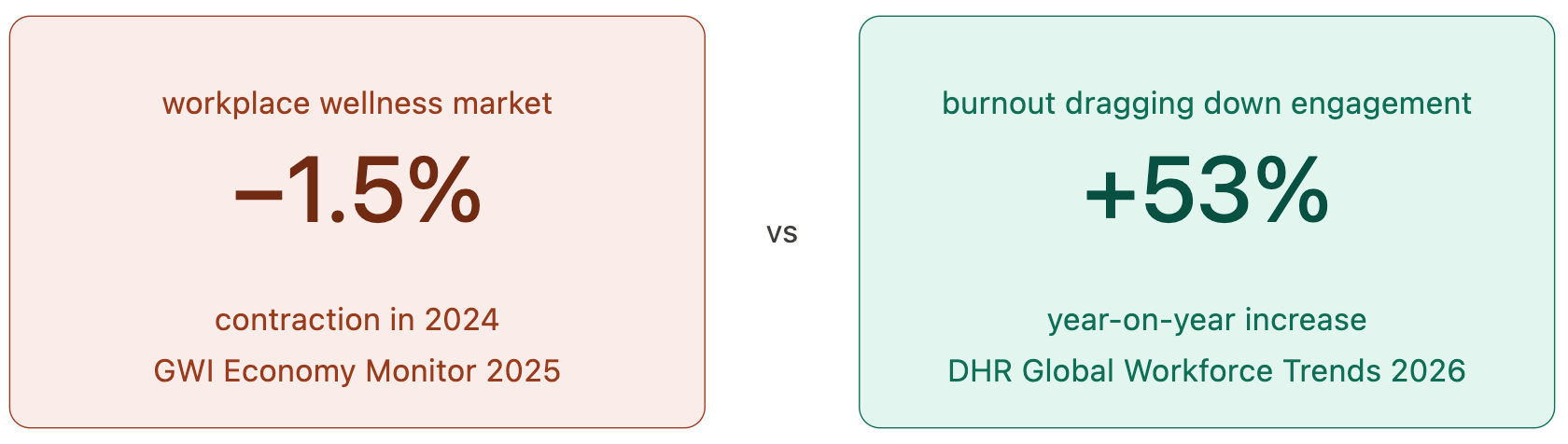
Burnout now actively drags down engagement for 52% of workers, up from 34% in 2025.
I want to sit with that for a moment, because I see this from the inside, and the DHR data confirms what I’ve been watching build for two years.
1. The programs and the problem are not talking to each other
Here is the tension at the center of this conversation.
According to the Global Wellness Institute’s 2025 Economy Monitor, the global workplace wellness market shrank 1.5% last year. The world’s largest market — North America — contracted 3.5%.
Companies are actively pulling back the investment, and at the same time, the workforce is deteriorating.
Burnout is steady at 83%. Engagement in freefall.
Overwhelming workload cited by 48% of workers as their primary burnout driver. Lack of recognition doubled, from 17% to 32%, as a cause of burnout in a single year.
These two things are happening simultaneously: less wellness investment, more workforce damage.
How does that make sense?
The conventional interpretation and my personal opinion are that wellness programs don’t work.
Harvard Business Review published exactly that argument in late 2024, and the Global Wellness Institute cited it as a structural driver of spending cuts.
But that is only half the diagnosis.
2. The real problem is not the work. It is the category
What is actually being cut is a specific kind of wellness spend — the programmatic, discretionary, HR-budget kind (step challenges, wellbeing apps, and yoga at lunch).
The category that sits in discretionary operational spend and gets reviewed every quarter alongside the coffee budget.
That is not the same thing as workforce resilience infrastructure.
It is not the same as psychological safety architecture.
It is not the same as cognitive load management embedded into how work is designed.
The professionals who get funded in 2026 are not selling more of what is being cut. They are selling the thing that replaces it, and they speak about it in a completely different language.
A 24-point engagement collapse is not a wellness problem.
In boardroom language, it is
a productivity risk
a retention liability
an operational continuity threat.
The DHR data shows that 91% of respondents say losing high-performing colleagues directly impacts the organisation through increased pressure on remaining teams, knowledge gaps, and lower motivation cascading downward.
That is a risk management conversation.
And it is a conversation that very few wellness professionals in this market are currently equipped to walk into.
3. The gap is the opportunity
Only 9.8% of the world’s workers have access to any workplace wellness program, according to the Global Wellness Institute’s 2025 Economy Monitor.
That number has been falling down from 10.1% in 2023.
Read that again. In a year when engagement collapsed and burnout deepened, worker access to wellness programs went down.
This is not a crowded market. This is a market where the old product is being defunded and the replacement has not yet been built.
The professionals who break into corporate wellness in 2026 will not be the ones who offer better versions of what’s being cut.
They will be the ones who show up with a different argument entirely.
One that connects workforce deterioration to measurable business risk and positions wellness not as a benefit but as an intervention.
That is a skills problem. Not a credentials problem. Not a network problem. A language and positioning problem.
The data is already making the case for you.
What most professionals are missing is knowing how to walk into the room.
The hardest part isn’t understanding the data. It’s knowing what to do with it when you’re sitting across from someone who controls a budget and has heard a hundred wellness pitches before.
Most of the people following this account are somewhere in the middle, not beginners, not yet in the room. They know the work is real. They just don’t have the language yet.
Below, I’m sharing the three-move framework I use when a leadership team is staring at numbers like these and doesn’t know what to do with them. Not a theory. The actual sequence: what to name first, how to frame the intervention, and the one sentence that keeps the conversation alive when a CFO pushes back.
You don’t need to be confident in using it. You need to be clear. Less than 1 AED a day.
Keep reading with a 7-day free trial
Subscribe to Wellness Intelligence to keep reading this post and get 7 days of free access to the full post archives.